
International
China Fires Warning on Taiwan as Abuja Forum Reaffirms Nigeria’s One-China Support

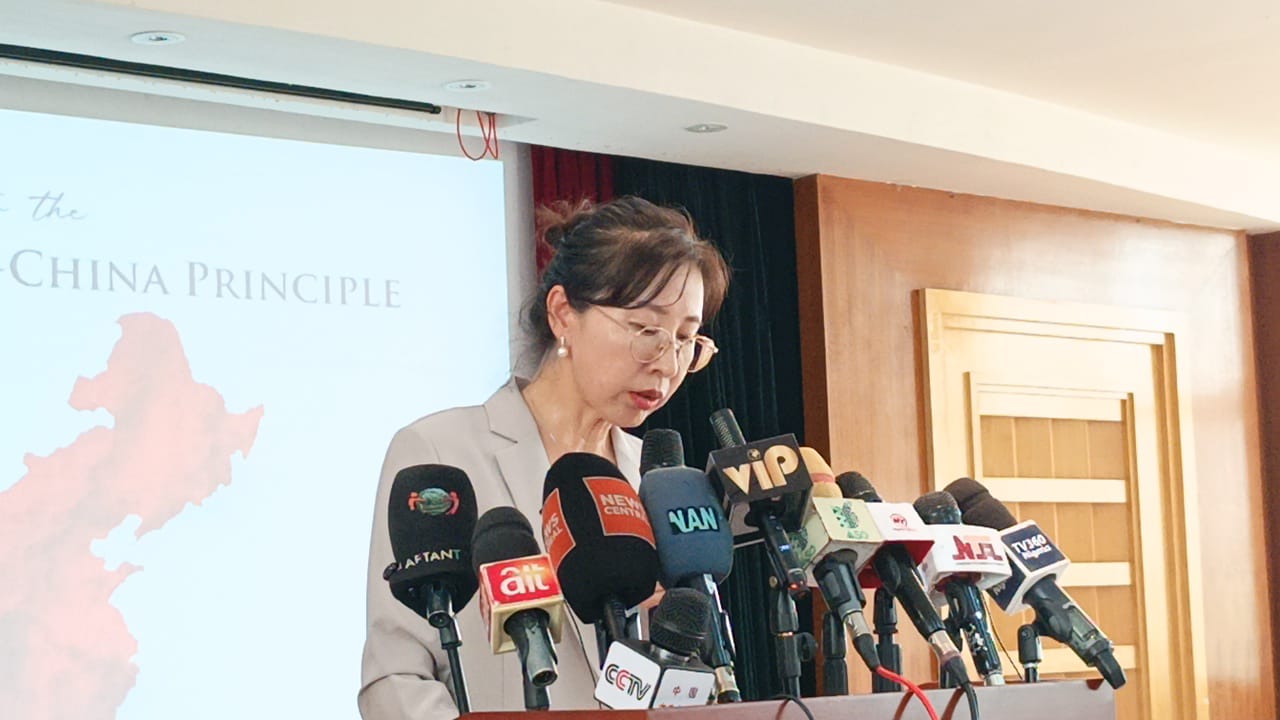
China on Thursday issued a fresh warning against moves promoting “Taiwan independence,” using a high-level media forum in Abuja to reinforce Beijing’s long-standing One-China policy and deepen diplomatic messaging around China-Nigeria relations.

Speaking at the media salon themed “Understanding the One-China Principle and Its Role in Deepening China-Nigeria Strategic Relations,” Counselor at the Chinese Embassy in Nigeria, Dong Hairong, declared that Taiwan remains “an inalienable part of Chinese territory” and cautioned against international actions Beijing views as undermining Chinese sovereignty.
The envoy cited recent developments, including the Taiwan leader’s visit to Eswatini and interactions involving Nigerian journalists in Taiwan, as signs of what she described as growing “misunderstandings” about the Taiwan issue within sections of the international community.

According to her, the One-China principle remains the political bedrock of China’s diplomatic engagement worldwide and continues to shape strategic relations between Beijing and Abuja.
“There is only one China and Taiwan is part of China. There is no such thing as ‘two Chinas’ or ‘one China, one Taiwan,’” Hairong stated.
The diplomat traced the origins of the Taiwan dispute to historical events following World War II, arguing that international agreements and United Nations Resolution 2758 of 1971 affirmed the People’s Republic of China as the sole legitimate representative of China at the UN.
Hairong praised Nigeria for maintaining consistent support for the One-China policy since both countries established diplomatic ties in 1971, noting that successive Nigerian governments had repeatedly backed China’s territorial integrity.
She referenced President Bola Ahmed Tinubu’s 2024 visit to China as a major diplomatic moment in which Nigeria again reiterated support for China’s reunification position and opposition to Taiwan independence.
The envoy said adherence to the One-China policy had helped strengthen bilateral cooperation in trade, infrastructure and regional development, highlighting China’s role in constructing the new ECOWAS headquarters in Abuja.
She also pointed to China’s recently announced zero-tariff policy for exports from 53 African countries, including Nigeria, saying products such as sesame, cocoa, ginger and cashew now enjoy broader access to the Chinese market.
Hairong further urged Nigerian journalists and media organisations to avoid terminologies that could imply recognition of Taiwan as a sovereign state, calling instead for what she described as “objective and impartial reporting” on Taiwan-related issues.
Also speaking at the forum, Provost of the Anti-Corruption Academy of Nigeria and Director of the Centre for Contemporary China-Africa Research, Sheriff Ghali Ibrahim, strongly defended the One-China principle and criticised Taiwan’s diplomatic engagements in Africa.
Ghali described Taiwan’s outreach to Eswatini as “thief-like diplomacy,” insisting that the overwhelming majority of African nations recognise only one China.
Drawing from international relations principles and the Treaty of Westphalia, the professor argued that Taiwan does not meet the requirements of sovereign statehood capable of sustaining formal diplomatic recognition.
He also commended Beijing’s handling of tensions across the Taiwan Strait, describing China as “patient” despite increasing geopolitical friction involving the United States, Russia, Iran and Ukraine.
According to him, 53 of Africa’s 54 countries currently recognise the One-China principle, leaving Eswatini as the continent’s only state maintaining diplomatic ties with Taiwan.
The Abuja media salon ended with renewed calls for stronger China-Nigeria cooperation, deeper media engagement and sustained support for the One-China policy as both countries seek to expand strategic ties across diplomacy, infrastructure, trade and regional development.