
International
Indus Waters Treaty: How India’s Concessions Became Pakistan’s Strategic Advantage

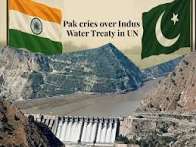
The 1960 Indus Waters Treaty remains one of the world’s most consequential water-sharing agreements, but critics in India increasingly argue that the pact institutionalised a deeply unequal arrangement that disproportionately benefited Pakistan while placing long-term restrictions on India’s own developmental rights.
Brokered by the World Bank and signed on September 19, 1960, by Indian Prime Minister Jawaharlal Nehru and Pakistani President Ayub Khan, the treaty divided the six-river Indus Basin system between the two countries following the 1947 partition of British India.
The river system — comprising the Indus, Jhelum, Chenab, Ravi, Beas and Sutlej rivers — remains central to agriculture, drinking water and power generation for millions across both nations.

Partition of Rivers and Strategic Realities
At partition, India emerged as the upper riparian state, controlling the headwaters of most rivers, while Pakistan inherited the fertile but water-dependent plains of Punjab.
Despite this geographical advantage, India agreed to a framework that allocated the three eastern rivers — Ravi, Beas and Sutlej — to India, while Pakistan received rights over the far larger western rivers — Indus, Jhelum and Chenab.
Critics argue that the arrangement represented a major concession by India, particularly because the western rivers account for nearly 80 percent of the basin’s total annual water flow, estimated at about 135 million acre-feet (MAF), compared to roughly 33 MAF from the eastern rivers retained by India.

Under the agreement, India was also barred from unrestricted use of western river waters despite portions flowing through Indian territory, with only limited non-consumptive uses such as run-of-river hydropower projects permitted under stringent technical conditions.
India Accepted Early, Pakistan Delayed
According to historical accounts of the negotiations, India accepted the World Bank’s initial 1954 proposal relatively quickly despite provisions that significantly restricted its future development options.
The proposal reportedly required India to abandon planned upstream developments on the Indus and Chenab rivers, forgo diversion of approximately six MAF from the Chenab, and avoid certain irrigation developments in Kutch.
Pakistan, however, delayed formal acceptance of the proposal for almost five years, eventually agreeing in December 1958.
Analysts critical of the treaty contend that this pattern established a long-standing diplomatic imbalance in which India’s willingness to compromise translated into additional concessions, while Pakistan benefited strategically from prolonged negotiations and obstruction.
Financial Burden on India
One of the most controversial aspects of the treaty remains the financial settlement attached to it.
India agreed to contribute approximately £62 million at the time estimated today at roughly $2.5 billion in present value to help Pakistan construct replacement infrastructure and canal systems linked to the western rivers, including projects in areas under Pakistan’s control.
Observers have often described this provision as unprecedented because the upstream country not only surrendered the majority of the river system’s waters but also financed the downstream country’s adaptation infrastructure.
Restrictions Applied Primarily to India
Another major criticism centres on what experts describe as asymmetrical obligations embedded within the treaty framework.
India’s activities on the western rivers remain subject to detailed technical restrictions, including limits on water storage capacity, irrigated cropped area and hydropower design specifications.
Projects undertaken by India must comply with strict operational and engineering criteria, particularly regarding pondage and reservoir management.
Pakistan, by contrast, faces no equivalent constraints or reciprocal obligations under the treaty regarding the eastern rivers or internal water infrastructure development.
Critics argue that this structure effectively subjects India’s lawful upstream development rights to external scrutiny while guaranteeing downstream benefits to Pakistan.
Renewed Debate Amid Regional Tensions
The treaty has increasingly come under scrutiny in India amid recurring tensions between the two nuclear-armed neighbours, especially following terror incidents and diplomatic disputes.
Supporters of revisiting the agreement argue that the treaty no longer reflects present-day geopolitical realities or India’s developmental and security interests.
Despite repeated tensions, however, the Indus Waters Treaty has survived wars, military standoffs and decades of political hostility, making it one of the few enduring bilateral agreements between India and Pakistan.