
Governance
FG Powers Federal University Lafia with 1.6MW Solar-Hybrid Plant

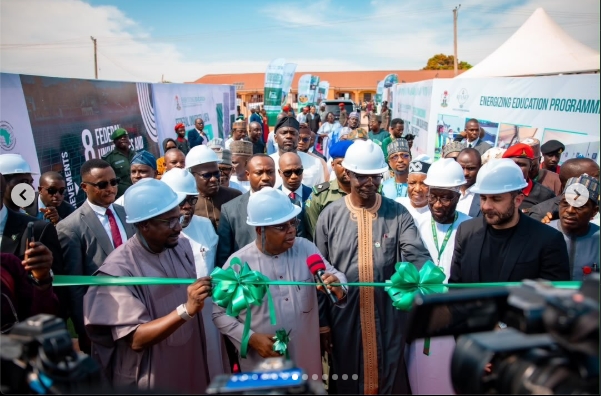
The Federal Government has commissioned a 1.6MW captive solar-hybrid power plant at the Federal University of Lafia, Nasarawa State, marking a significant milestone in its commitment to providing reliable, affordable and sustainable electricity to federal universities across the country.
The project was delivered under Phase III of the Federal Government’s Energizing Education Programme (EEP), an initiative designed to address the electricity needs of federal universities and affiliated teaching hospitals through the deployment of clean, reliable and sustainable power infrastructure.
The EEP is being implemented by the Rural Electrification Agency (REA) through the Nigeria Electrification Project, with Phase III receiving financial support from the African Development Bank (AfDB). The programme builds on the achievements of Phases I and II, which were supported by the Federal Government and the World Bank, respectively.
EEP Phase III covers eight federal universities and one teaching hospital across Nigeria, providing sustainable electricity infrastructure alongside complementary interventions in technical training, research and human capital development.
The programme also creates opportunities for 160 female students in Science, Technology, Engineering and Mathematics (STEM) to build technical confidence and acquire practical skills in renewable energy systems.
The commissioning ceremony attracted key stakeholders from the power and education sectors, including the Honourable Minister of Power, Chief Joseph O. Tegbe; the Managing Director/Chief Executive Officer of REA, Alhaji Abba Aliyu; the Vice-Chancellor of the Federal University of Lafia, Professor Mohammed Isa; the Executive Governor of Nasarawa State, Engineer Abdullahi A. Sule; university management; and other distinguished guests.
Speaking at the ceremony, the Honourable Minister of Power, Chief Joseph O. Tegbe, reaffirmed the Federal Government’s commitment to expanding access to clean, dependable and sustainable electricity. He emphasised the importance of renewable energy solutions in strengthening public institutions and supporting productive economic activities.
He said:
“The federal government will continue its effort to provide reliable and clean electricity access every Nigerians. Investment in electricity is being directed toward the service and productive activities that improve lives. This investment brings welcome relief to the university that was pending about 30 million impound for an electricity bill and still contending with unreliable supply.
“The new 1.6 MW and close to 3MW battery storage capacity will operate excellently to provide reliable power to our lecture rooms, laboratories, ICT centers and offices and student hostels. For student and staff this prevent interruption to study and learning. It very imperative for us to know that across the world today solar power is not alternative, it is a power source and another mesh of energy. mini grids are built in other areas where we need captive power supply. I will continue to be an advocate of captive power supply through renewable energy.”
Beyond the installation of the 1.6MW solar-hybrid power plant, the project includes the rehabilitation of the university’s existing electricity distribution network, the construction of a Workshop Training Centre (WTC) for research and technical training, and the installation of solar-powered streetlights.
With the plant completed and operational, the university is now enjoying reliable electricity across the entire campus, covering both critical and non-critical facilities, including student hostels.
The development represents a major improvement in the institution’s electricity supply and provides a more stable energy environment for teaching, learning, research, healthcare-related academic activities, digital services and other essential university operations.
The improved electricity supply is also expected to reduce the university’s dependence on conventional grid electricity, lower its energy expenditure and provide greater operational certainty for academic and administrative activities.
Another key component of the intervention is the Workshop Training Centre, designed to serve as a dedicated hub for research, technical training and practical learning. The facility will strengthen the university’s capacity to develop technical expertise, promote innovation and contribute to Nigeria’s growing renewable energy ecosystem.
The programme’s human capital development component further reinforces its commitment to inclusive participation in the energy transition by equipping students with practical exposure and skills relevant to the renewable energy industry.
In his remarks, the Managing Director/Chief Executive Officer of REA, Alhaji Abba Aliyu, described the intervention as a strategic investment in Nigeria’s human capital, academic development and technological advancement. He noted that reliable electricity is fundamental to the effective delivery of educational services.
He said:
“Electricity to university students is not an abstract infrastructure investment, it is different between study and being forced to stop, due to lack of electricity. Electricity access is not about lighting buildings, it is about illuminating possibilities, generating opportunities, connecting the entire generation of Nigeria to their future.
“The plant being commissioned today is more than a power plant, it is an investment in Nigeria’s human capital, research capacity, technological competitiveness and academic future. The universities are not ordinary electricity consumers, they are engines of national development. We cannot expect the university to compete globally when they struggle for reliable electricity. Under the renewed hope agenda of the present, the federal government deliberately repositioned electricity access as a condition for economic transformation.
“Electricity must be delivered when it can unlock better economic and social value in our home, school, hospital, agriculture and industries. Nasarawa state occupied an important place in the evolution of Nigeria’s distributed renewable energy sector.”
In his welcome address, the Vice-Chancellor of the Federal University of Lafia, Professor Mohammed Isa, expressed appreciation to the Federal Government, the Ministry of Power, REA and the African Development Bank for delivering the project.
He described the intervention as a strategic development that would significantly strengthen the university’s capacity to fulfil its academic mandate.
He said:
“For the past few months since the operation of the plant, we had stopped paying 30million naira to DISCO monthly. The 1.6MW captive solar hybrid plant we are commissioning today is a strategic intervention that will significantly strengthen the university capacity to deliver on its mandate. The project will impact over 30,000 students including academics and non-academic staff and surrounding communities.
The intervention will promote our teaching, research and improve the delivery of digital and ideological service, straightening security, create opportunity for practical training in renewable energy.”
The Executive Governor of Nasarawa State, Engineer Abdullahi A. Sule, in his closing remarks, commended the Federal Government, the Honourable Minister of Power, the African Development Bank and REA for their contributions to the successful delivery of the project.
He particularly appreciated the intervention for addressing the university’s longstanding electricity challenges, noting the significant relief it would provide from the burden of high electricity bills and unreliable power supply from the national grid.
The Governor also acknowledged the importance of reliable electricity to the delivery of quality education, research and institutional development, describing the project as an important contribution to improving the learning environment and supporting the growth of the education sector in Nasarawa State.
The commissioning of the 1.6MW captive solar-hybrid power plant at the Federal University of Lafia underscores the Federal Government’s commitment to expanding access to reliable and sustainable electricity in public institutions through innovative renewable energy solutions.
It also demonstrates the importance of strategic partnerships between the Federal Government, development partners and implementing institutions in addressing Nigeria’s electricity access challenges.
Through the Energizing Education Programme, REA continues to deploy dedicated power infrastructure to federal tertiary institutions, strengthening energy security, improving academic and research environments, reducing institutional energy costs and creating opportunities for technical skills development.
These interventions align with the Federal Government’s broader commitment to leveraging sustainable energy access as a catalyst for national development, human capital advancement and economic growth.
ABOUT THE RURAL ELECTRIFICATION AGENCY (REA)
The Rural Electrification Agency (REA) is the Federal Government of Nigeria’s implementing agency responsible for promoting and coordinating rural electrification initiatives across the country.
Through programmes such as the Nigeria Electrification Project (NEP) and the Energizing Education Programme (EEP), the Agency works to expand electricity access through sustainable and innovative solutions, including renewable energy, mini-grids and solar-hybrid power systems.