News
From Abuja to all 774 LGAs, NCC pushes bold fibre expansion plans to power connectivity, innovation, and inclusive digital growth.

The Nigerian Communications Commission (NCC) has reiterated its commitment to fast-tracking Nigeria’s digital transformation through strategic partnerships and continuous investment in human capital development, describing both as essential to expanding broadband access nationwide.
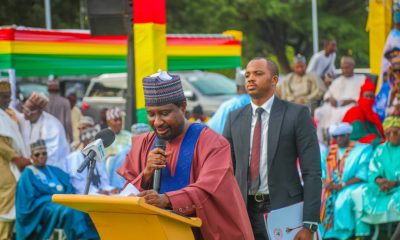
This was disclosed by the Executive Vice Chairman (EVC) of NCC, Dr. Aminu Maida, in a goodwill message presented at a Strategic Fibre Optics Training Workshop held in Abuja.
The five-day intensive programme was organised by the International Telecommunication Union (ITU) in collaboration with the Digital Bridge Institute (DBI), with support from the European Union (EU). It is designed to strengthen digital capacity and improve policy development among participating countries.
Represented by NCC’s Executive Commissioner, Technical Services, Abraham Oshadami, Maida described the workshop, themed “Strategic Fibre Optics Infrastructure Deployment and Regulatory Management,” as timely and highly relevant.
He stressed that a robust and properly regulated fibre infrastructure is the foundation of any meaningful digital transformation effort.
Maida explained that Nigeria’s goal of bridging the digital divide and increasing broadband penetration depends largely on strategic fibre deployment. He noted that such deployment serves as a catalyst for economic growth and enhances financial inclusion, education, healthcare delivery, agricultural productivity, and efficient public services.
He further revealed that the Federal Government, through Project BRIDGE (Building Resilient Digital Infrastructure for Growth) under the Ministry of Communications, Innovation and Digital Economy, plans to roll out an additional 90,000 kilometres of fibre optic cable across the country.
According to him, the initiative aims to extend connectivity to all 774 Local Government Areas, thereby promoting digital inclusion nationwide.
Despite these efforts, Maida identified ongoing challenges, including high Right of Way (RoW) charges, bureaucratic bottlenecks at subnational levels, and infrastructure vandalism, as major obstacles to broadband expansion.
He, however, noted that the NCC has strengthened collaboration with regulatory agencies, state governments, and security institutions to tackle these issues and ensure smooth deployment and protection of telecom infrastructure.
He added that sustained advocacy by the commission has begun to yield results, with 13 states already waiving RoW charges, thereby attracting more investments from telecom operators.
Maida also highlighted a 2024 presidential directive, secured through joint efforts by the ministry, the Office of the National Security Adviser, and NCC, which classified telecommunications infrastructure as Critical National Information Infrastructure (CNI), enhancing its protection nationwide.
Reaffirming the commission’s dedication to human capital development, he emphasized that a skilled workforce is crucial to achieving a fully connected and digitally empowered Nigeria.
He expressed confidence that the training workshop would equip participants with the knowledge and tools needed to improve regulatory efficiency, strengthen stakeholder engagement, and accelerate fibre deployment nationwide.
In her goodwill message, Inga Stefanowicz, Head of Section, Green and Digital Economy at the EU Delegation, highlighted the importance of digital infrastructure within the EU’s global strategy.
She explained that the strategy focuses on key sectors such as digital infrastructure, transport, energy, healthcare, and education, and has been actively implemented in several African countries, including Nigeria.
Stefanowicz noted that the scale of infrastructure development required makes it impossible for governments alone to bear the financial burden, stressing the need for strong private sector participation.
She referenced the EU’s digital economy package for Nigeria, launched in 2022, which includes investments worth 820 million euros, with 160 million euros in grants, alongside additional development financing.
According to her, the initiative supports various aspects of the digital ecosystem, including digital skills development, innovation hubs, digital enterprises, and public digital infrastructure, with a strong focus on fibre optic expansion.
She added that the programme is expected to strengthen partnerships between Europe and Africa while encouraging collaboration across both public and private sectors.
Stefanowicz urged participants to actively engage in the training and take advantage of future opportunities provided by the EU and its partners, emphasizing that digital infrastructure is key to sustainable digital transformation.
The workshop is expected to leave participants better equipped to contribute to policy formulation and implementation, ultimately advancing Nigeria’s pursuit of a resilient, inclusive, and technology-driven economy.