News
HOW NIGERIA’S MILITARY SEIZED OVER 400 STARLINK DEVICES FROM BOKO HARAM AND ISWAP — THE SATELLITE INTERNET EMPIRE OF TERROR, ITS PRICE TAG, AND THE INVISIBLE NETWORK THAT SHIELDED THEM

_By Sam Agogo_
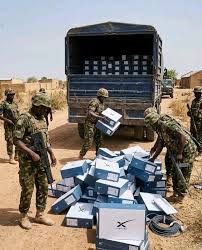
In what security experts are already describing as one of the most consequential counter-insurgency intelligence victories in Nigeria’s modern military history, troops of Operation HADIN KAI have successfully intercepted and seized over 400 Starlink satellite internet terminals directly from the operational strongholds of Boko Haram and the Islamic State West Africa Province — known widely as ISWAP. The devices, manufactured by SpaceX and owned by American billionaire Elon Musk, were not crude field radios or repurposed civilian handsets. They were sophisticated, subscription-based, high-speed satellite internet systems — the very same technology used by businesses, hospitals, and schools across Nigeria — deployed with deliberate strategic intent by some of the most dangerous terrorist organisations on the African continent to coordinate attacks, move fighters, manage logistics, upload propaganda, and communicate across vast, remote, and militarily hostile terrain entirely beyond the reach of Nigeria’s conventional telecommunications infrastructure. The seizure, announced by Brigadier-General Beyidi Martins, Commander of Sector 2, Operation HADIN KAI, at a press briefing in Damaturu, Yobe State, has forced an urgent and uncomfortable national conversation — not only about the battlefield ingenuity of Nigeria’s military, but about the astonishing financial resources of these terror groups, the criminal supply chains that arm them with commercial technology, and the deep structural gaps in global satellite internet regulation that made this invisible empire of terror possible in the first place.
“The terrorists use the Starlink satellite network,” Brig.-Gen. Martins told reporters, his voice measured but his words carrying the weight of a seismic intelligence breakthrough. “And I think so far within this sector, we have arrested over 400 pieces of the Starlink network — over 400 pieces. And that has helped to deny them the ability to be able to get a connection easily.”
The revelation sent shockwaves through Nigeria’s security architecture, the telecommunications industry, the international counter-terrorism community, and — perhaps most significantly — the boardrooms of technology companies whose products have become, wittingly or not, instruments in one of Africa’s longest-running insurgencies.
How had jihadi fighters, hiding in the treacherous forests and semi-arid plains of Nigeria’s North-East, acquired not one or two, but over 400 units of one of the world’s most advanced consumer satellite internet systems? Who registered these devices? Who paid for them? And why, with all the surveillance power of the Nigerian state, could nobody track them?
What we found is a story not merely of terrorism, but of technology, money, criminal ingenuity, and a dangerous gap in the global regulatory framework that governs satellite internet — a gap that, if not urgently closed, will continue to cost Nigerian lives.
The 400-plus Starlink terminals were recovered across multiple sustained military operations conducted in three of the most dangerous and remote locations in all of sub-Saharan Africa.
The first is the Sambisa Forest — a vast, dense woodland straddling Borno and Adamawa states that has served as Boko Haram’s primary fortress since the group seized it from the Nigerian government in 2014. Once a government game reserve teeming with wildlife, Sambisa is today a fortified jihadist stronghold, laced with landmines, booby traps, and hidden tunnels, covering an estimated 60,000 square kilometres of near-impenetrable terrain.
The second is the Timbuktu Triangle — a lawless, sparsely populated badland at the intersection of Yobe State, Borno State, and the Republic of Niger, where ISWAP cells operate with near total impunity. This corridor has become one of the most active terrorist transit routes on the African continent.
The third encompasses various other unnamed enclaves across the North-East theatre — scattered camps in Adamawa state borderlands and lakeside hideouts along the shrinking shoreline of Lake Chad, where Nigeria, Cameroon, Chad, and Niger share a porous, barely patrolled water boundary.
These are places where Nigerian mobile network operators — MTN, Airtel, Glo, and 9Mobile — have virtually no signal presence. Roads are mined or non-existent. Government authority has been entirely absent for over a decade. In these environments, conventional communications infrastructure simply does not reach. But space, as it turns out, reaches everywhere.
With over 10,000 satellites now in Low Earth Orbit, Starlink provides near-total continental coverage across Africa. For a terror cell hiding in the heart of Sambisa Forest, a Starlink dish delivers the same internet speeds enjoyed by a business in a Lagos office block — enabling encrypted messaging, real-time video coordination calls, propaganda production and uploads, financial transactions, and operational planning that was previously impossible from such remote locations.
“The lifeblood of terrorist activities is logistics resupply,” Brig.-Gen. Martins stated. “And we are deliberately denying them freedom to move supplies, communication equipment, fuel, and other operational items.”
Military analysts described the seizure as “a game-changer in the intelligence war.” For years, one of the greatest frustrations of Nigerian security forces has been the inability to intercept or disrupt the internal communications of Boko Haram and ISWAP. Traditional signal intelligence methods — monitoring GSM calls, intercepting military radio — had become increasingly ineffective as the groups evolved and adapted. Starlink terminals were, for these groups, the answer to a critical operational problem: reliable, high-speed internet connectivity that works from any location on earth with a clear view of the sky, and that is extraordinarily difficult to block, monitor, or intercept at ground level.
The seizure of 400 such devices in a single military sector represents the most significant disruption to terrorist communications infrastructure in the history of Operation HADIN KAI. Without the ability to coordinate securely, receive supply instructions, share battlefield intelligence, and upload propaganda to recruit new fighters, the operational capacity of both Boko Haram and ISWAP is significantly degraded.
Before understanding how terrorists acquired their satellite arsenal, Nigerians must grasp exactly what Boko Haram and ISWAP were purchasing — and at what extraordinary financial cost. Starlink is not a cheap product, even by the standards of Nigeria’s growing consumer technology market. Its price structure has two separate components: a one-time hardware purchase, and an ongoing monthly subscription that must be paid continuously to keep every single device connected to SpaceX’s satellite network.
The Starlink Standard Kit in Nigeria costs approximately ₦590,000 — a one-time purchase that includes the satellite dish, Wi-Fi router, mounting hardware, and all necessary cables. The system requires no technician and is designed for self-installation using a smartphone app, making it dangerously accessible even in the remotest locations on earth.
A more portable option — the Starlink Mini Kit — is also available at approximately ₦318,000. It is smaller, lighter, and designed for users who move frequently. Security analysts note with deep unease that this compact model is almost purpose-built for the operational needs of a mobile terror cell: easy to pack, easy to conceal during military sweeps, and easy to reassemble in a new camp the following morning.
On the black market — where Boko Haram and ISWAP primarily source their devices through criminal intermediaries — third-party resellers typically charge between ₦620,000 and ₦690,000 for the standard kit, a premium of between ₦30,000 and ₦100,000 above the official price. This markup funds the criminal logistics network that carries the devices from city tech markets into forest camps.
Hardware is only the beginning. Every single Starlink terminal requires an active monthly subscription to remain connected to SpaceX’s global satellite network. Without this payment, the device is nothing more than an expensive dish pointed at the sky.
The monthly subscription fee for Starlink in Nigeria currently stands at ₦57,000 for the residential plan. For business use — designed for multiple simultaneous users and higher data capacity — the cost is approximately ₦159,000 per month. This residential rate itself represents a 50% increase from the previous fee of ₦38,000, which took effect from May 30, 2025, in line with the Nigerian Communications Commission’s broad telecom tariff adjustment — the first such regulatory revision in over a decade.
In the illicit supply chain used by terror groups, subscription costs are even steeper. Researchers document traffickers charging terrorist end-users up to double the official monthly rate — meaning ISWAP and Boko Haram cells may be paying as much as ₦114,000 per device per month. The markup is the trafficker’s profit margin for managing the SpaceX account, collecting payment in cash or mobile money, and shielding the true identity of the end-user from SpaceX’s billing records.
Based on official 2026 Nigerian pricing, the minimum financial investment required to build and sustain the 400-device Starlink network seized by the Nigerian military is as follows:
Item
Total Cost
Hardware — 400 Standard Kits × ₦590,000
₦236,000,000
Monthly Subscriptions — 400 × ₦57,000
₦22,800,000 per month
Annual Subscription Bill
₦273,600,000 per year
Total First-Year Investment (Official Rate)
≈ ₦509,600,000
At black-market subscription rates, that annual total climbs well beyond ₦800 million.
In plain terms: Boko Haram and ISWAP have been running a satellite internet empire worth between half a billion and nearly one billion naira — every single year — just to keep their hidden communication network alive. This is not the spending of a ragged, desperate insurgency scratching for survival in the bush. This is organised, financially calculated, and deliberately sustained terrorism — bankrolled through livestock rustling, community extortion, kidnapping ransoms, and international jihadist funding networks that collectively generate enough cash to keep 400 satellite dishes pointing skyward, deep inside Nigeria’s most dangerous forests, month after month after month.
Starlink kits are purchased through legitimate civilian channels in Nigeria and then smuggled northward into terror-controlled areas through a sophisticated criminal logistics network. Researchers document a clearly defined pipeline: devices are procured in major Nigerian cities, transit through commercial hubs like Kano and Maiduguri, are stored in warehouses in border towns like Maradi and Zinder in neighbouring Niger, and are finally transported deep into extremist strongholds in the Lake Chad basin and the Sambisa Forest corridor.
“It’s easy to move the kits,” one trafficker based in Maradi, Niger, told researchers. “You just pay the drivers and the police a little money and they let you pass without any problems. Everyone knows how it works.”
Kits are sometimes disassembled into their component parts — the satellite dish, the Wi-Fi router, the power supply — and concealed among ordinary household goods, motorcycle spare parts, food items, or building materials to defeat border inspection. The modular nature of the product, a design feature intended to make installation easy for rural consumers, becomes a tool for criminal concealment.
Brig.-Gen. Martins was emphatic on a deeply uncomfortable truth that many Nigerians prefer not to confront: some Nigerian civilians are not passive bystanders in this crisis — they are active, knowing participants in the terrorist supply chain that sustains attacks on their own countrymen.
“There is a high level of collusion between some members of the civil populace and the terrorists. Some do it willingly, while others are forced through threats and coercion,” he stated bluntly.
Troops have arrested hundreds of logistics suppliers, couriers, vehicle operators, and market traders linked to terrorist resupply operations across the North-East. “Arrests are made on a daily basis. So far, we have disrupted over 400 logistics-related cases and networks supporting terrorist operations,” the commander confirmed.
The illicit Starlink supply chain originating in Nigeria has also fuelled a Sahel-wide extremist communications revolution. Devices have been documented appearing across Niger, Chad, Mali, and Burkina Faso — carried along the same smuggling corridors used for weapons, drugs, and human trafficking. In June 2024, a video released by al-Qaeda-affiliated Jama’at Nasr al-Islam wal-Muslimin during a military operation in the Gao region of eastern Mali showed fighters actively using Starlink terminals. Analysts conclude that illicit Starlink systems smuggled from Nigeria likely played a measurable role in the rapid escalation of extremist violence in Niger following its 2023 military coup, during which extremist attacks nearly doubled within a single year.
Every Starlink terminal must be registered to a SpaceX account. An email address, a payment method, and a service address are required. In theory, this creates a traceable paper trail. In practice, across West Africa’s conflict zones, that trail is deliberately, systematically, and expertly obscured.
Devices are purchased using the identities of legitimate Nigerian civilians — traders, farmers, teachers, community leaders — who either willingly sell their names and account credentials for a fee, or are coerced through threats into registering accounts they will never actually use. Fake identities assembled from forged documents have also been exploited extensively, particularly given the low identity verification requirements at point of purchase in local Nigerian tech markets, where Starlink kits are sold without any biometric check against the national identity database.
In multiple documented cases, a single account registered to one individual manages dozens — and in some cases over a hundred — Starlink terminals simultaneously. The registered account holder serves as a professional middleman with no direct knowledge of where the devices are physically located. Critically, the physical Starlink device — once activated — does not need to remain at its registered service address to function. A terminal activated to an address in Maiduguri works identically in the heart of Sambisa Forest. This design feature, intended to allow travellers and remote workers to take their internet with them, has become a catastrophic security vulnerability that no regulatory framework currently addresses.
Terrorist groups do not pay SpaceX directly. They rely on a carefully constructed layered intermediary network. Traffickers who supply the devices also control the subscription accounts. They collect cash payments — or mobile money transfers through platforms like OPay and PalmPay — from the terror cells at double the official rate, then use legitimate Nigerian bank accounts or international payment cards registered to shell entities to pay SpaceX. By the time the transaction reaches SpaceX’s servers, it is completely indistinguishable from any legitimate Nigerian subscriber payment. There is no flag. There is no alert. There is no automatic trigger.
Local livestock markets have also been systematically exploited by insurgents to launder proceeds from raiding and kidnapping. Rustled animals are driven to open markets and sold for cash, recycled into operational expenses including Starlink subscriptions. “If animals are not properly identified, they will not be sold. Through that arrangement, we are tracking and disrupting their sources of financing,” Martins explained. Beyond livestock, ISWAP levies taxes on communities it controls, extorts truck drivers on major highways, collects kidnapping ransoms, and benefits from international jihadist funding channels — a diversified financial empire that makes sustaining 400 satellite subscriptions entirely feasible.
Traditional telecommunications monitoring in Nigeria works through a clear architecture. All calls, texts, and mobile data pass through physical ground-based infrastructure — cell towers and core telecom networks. Intelligence agencies maintain lawful interception agreements with MTN, Airtel, Glo, and 9Mobile, allowing them to request call records, location data, and communication content for identified targets.
Starlink bypasses this entire architecture completely. A user in Sambisa Forest transmits data directly to satellites orbiting 550 kilometres above the Earth. The signal travels to space and back down to SpaceX’s ground stations — never touching a single Nigerian BTS tower or passing through a single Nigerian core network node. There is nothing for Nigerian interception systems to intercept.
Even if a Nigerian intelligence agency physically intercepted the radio signals passing between a Starlink terminal and the satellites above — a technically demanding task — they would immediately face a second impenetrable wall: all Starlink traffic is encrypted in transit. The content of whatever terrorists are communicating remains cryptographically sealed. On top of Starlink’s built-in encryption, armed groups use end-to-end encrypted messaging applications — Signal, Telegram, WhatsApp, and in some cases custom-built platforms — adding further layers that local intelligence services cannot independently penetrate.
Starlink is an American company subject primarily to United States federal law. When Nigerian intelligence agencies require data about specific Starlink users, they cannot simply demand this from SpaceX the way they would from MTN or Airtel. They must initiate a formal Mutual Legal Assistance Treaty process routed through the Nigerian federal government and the United States Department of Justice — a process that routinely takes between six months and two years to complete, even in urgent terrorism cases. Unlike Nigerian telecoms licensed by the NCC and obligated to comply immediately with local lawful interception orders, SpaceX has no equivalent regulatory obligation to the Nigerian state. This asymmetry is the single greatest structural advantage the terrorists have exploited.
Unlike GSM mobile phones requiring registered, traceable SIM cards, Starlink terminals require only an internet account — one that can be and routinely is registered using false, stolen, or coerced identities. There is no physical SIM card to seize, clone, or track. There is no IMEI number appearing on any Nigerian network operator’s system. The device is, from the perspective of traditional telecoms surveillance, completely invisible.
A Starlink terminal can be disassembled and packed into a standard bag in under ten minutes. When not in use, the dish can be concealed beneath vegetation, tarpaulins, or inside buildings — effectively invisible to aerial surveillance and drone reconnaissance. And unlike conventional mobile phones, which reveal their location to operators through the cell towers they connect to, a Starlink terminal reveals its location to no Nigerian system whatsoever. The forest offers no natural communications isolation anymore. Any location with a clear view of the sky is now a potentially fully connected operational headquarters.
Nigeria’s military deserves unequivocal credit for this landmark seizure. But the structural vulnerabilities that allowed these devices to reach the Sambisa Forest in the first place remain dangerously open.
The Nigerian Communications Commission must immediately mandate biometric NIMC verification at every point of Starlink hardware sale in the country — making it substantially harder to register devices using stolen or fabricated identities. The federal government must urgently negotiate a dedicated bilateral data-sharing arrangement with the United States and directly with SpaceX, establishing a fast-track mechanism for account deactivation and user data disclosure in active terrorism cases — bypassing the MLAT process entirely unsuited to the speed of military operations.
The Nigerian military should explore the acquisition of specialised radio frequency direction-finding equipment capable of geolocating active Starlink terminals from aircraft or drones. Active Starlink dishes emit distinctive and detectable radio signals that, with the right airborne equipment, can be triangulated to within metres — potentially allowing the military to locate hidden terror camps currently undetectable by conventional aerial surveillance. This technology exists. NATO nations have deployed it. Nigeria needs it urgently.
SpaceX must establish a dedicated Africa Security Liaison Unit — a permanent team responsible for working proactively with African governments and intelligence agencies to identify and deactivate accounts used by proscribed terrorist organisations. Response times measured in months or years are unacceptable when terrorist attacks are planned in days. SpaceX should also apply geofencing technology to restrict Starlink service within designated security exclusion zones around active conflict areas — a tool the company has demonstrated it possesses and is willing to deploy in other global conflict contexts. Mandatory biometric identity verification for all new African account registrations would be a proportionate and immediately implementable first step.
The seizure of over 400 Starlink terminals is, above all, a symptom of a deeper global challenge: the dual-use nature of transformative commercial technology. The same satellites delivering connectivity to rural farmers in Borno, to remote schools in Taraba, to hospitals in Kebbi, are being exploited by mass murderers in the Sambisa Forest. Technology companies cannot continue to treat the weaponisation of their platforms in conflict zones as someone else’s problem. When your product is actively sustaining one of Africa’s deadliest insurgencies, the obligation to act is not merely legal — it is moral.
Since 2009, the Boko Haram and ISWAP insurgency has claimed just under 53,000 civilian lives in targeted political violence across Nigeria’s North-East. Over two million people have been forcibly displaced from their homes, their farms, their communities. More than seven million people across the Lake Chad Basin — spanning Nigeria, Cameroon, Chad, and Niger — remain in acute need of humanitarian assistance. Children have grown up knowing nothing but war. Entire towns have been emptied, burned, and forgotten.
Every Starlink terminal seized by Operation HADIN KAI is not merely a piece of technology recovered from the forest. It is a potential attack that may never happen. A village that may not be raided tonight. A farmer who may make it home. A mother who may not receive the news that will break her. A child who may live to see peace.
The soldiers of Operation HADIN KAI operate in conditions that most Nigerians cannot imagine and most of the world does not see. They deserve not just our recognition, our prayers, and our gratitude. They deserve every resource, every diplomatic tool, every technological advantage, and every policy decision this nation is capable of delivering in their support.
Nigeria is fighting for its North-East. It deserves a world that fights with it.
For comments, reflections, and further conversation:
Email: samuelagogo4one@yahoo.com
Phone: +234 706 276 0296