International
India Moves To Bridge BRICS Divisions Ahead Of New Delhi Summit

By Iyojo Ameh
India is stepping up diplomatic efforts to bridge differences among members of the expanded BRICS grouping ahead of the bloc’s leaders’ summit in New Delhi, with negotiations over a joint declaration emerging as a key test of the host country’s ability to forge consensus.
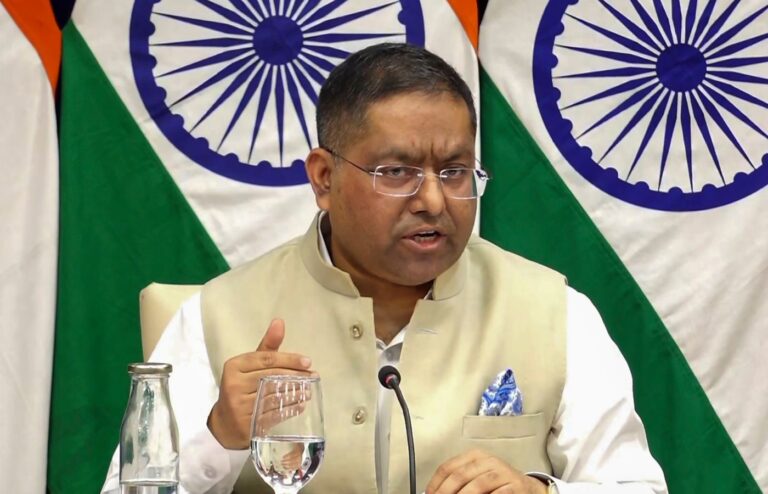
India’s Ministry of External Affairs spokesperson and Additional Secretary, Randhir Jaiswal, said New Delhi was engaging all members as partners and seeking to strengthen cooperation despite differences over geopolitical and economic issues.

Speaking at a dinner for journalists and content creators in New Delhi ahead of the summit, Jaiswal said, “India is friends with all BRICS member countries. As friends, it is our intention to bring all our partners together.”
Asked whether India had undertaken any specific initiative to narrow divisions within the bloc, the Indian diplomat pointed to negotiations on the summit’s joint declaration.

“You will have to wait for the joint statement,” he said. “The joint statement is being negotiated and there you will see how India brings everybody together.”
Jaiswal said negotiations were being conducted collectively with all BRICS members but declined to disclose the countries involved in particular disagreements.
India will host the 18th BRICS Leaders’ Summit on September 12 and 13, 2026, at a time when the grouping is navigating a significantly more complex diplomatic landscape following its expansion to 11 members.
Under its 2026 chairmanship, India has placed resilience, innovation, cooperation and sustainability at the centre of its BRICS agenda, while pushing development priorities and seeking to strengthen the voice of the Global South.
The economic agenda includes the proposed BRICS Economic Partnership 2030, greater cooperation in trade in services, stronger and more resilient supply chains, and improved financing opportunities for small and medium-sized enterprises.
But the enlarged membership has also brought together countries with competing strategic, regional and economic interests, making consensus more difficult, particularly on politically sensitive matters.
One example is the tension between Iran and the United Arab Emirates. During discussions surrounding the BRICS foreign ministers’ meeting in New Delhi in May, the UAE rejected Iranian allegations and reaffirmed its sovereignty and right to protect its national security.
India and China also continue to manage strategic differences despite recent efforts to stabilise bilateral relations following the 2020 border clashes. Disagreements over security, technology, trade and market access remain significant constraints on deeper cooperation between the two Asian powers.
A separate fault line exists between Egypt and Ethiopia over the Grand Ethiopian Renaissance Dam and the use of Nile waters.
The issue received renewed attention following Chinese President Xi Jinping’s state visit to Egypt from September 1 to 2. A joint communiqué issued during the visit recognised Egypt’s “legitimate right” to safeguard its water, food and development interests and called on Nile Basin states to comply with international law and obligations relating to the prevention of harm.
Although the statement did not explicitly endorse Egypt’s position against Ethiopia, its reference to Nile-related concerns adds another layer to the diplomatic calculations within BRICS, where China, Egypt and Ethiopia are all members.
Economic differences could also test the bloc’s unity. Russia and China have advocated greater use of national currencies and alternatives to the US dollar in cross-border transactions, while other members have maintained different priorities and approaches to international trade and finance.
For India, the New Delhi summit therefore represents more than an opportunity to showcase its leadership of BRICS. It will be a test of whether the expanded grouping can translate its growing influence in the Global South into practical cooperation while managing increasingly divergent national interests.
The success of the summit may ultimately depend on how far India can balance those competing priorities and secure language in the joint declaration that all 11 members can accept.