
International
JUST IN: Fresh Protests Erupt in Iran as Trump Weighs Strikes, Targets Khamenei’s Son and Senior Clerics

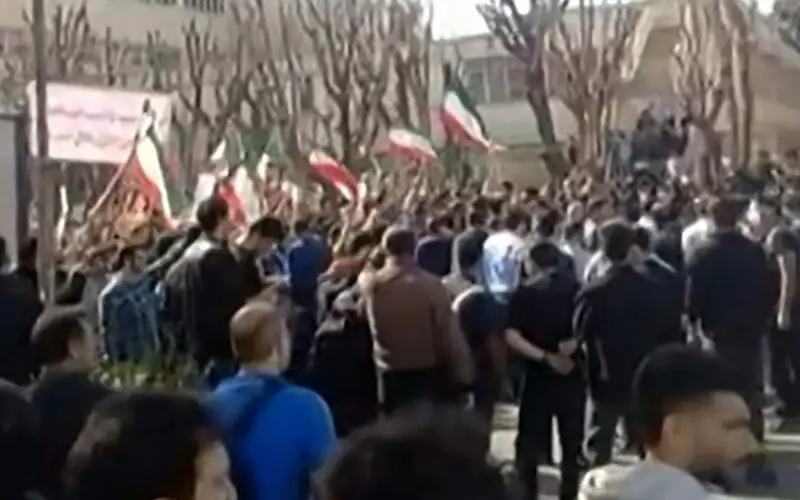
Despite reports that about 30,000 peaceful demonstrators were killed by security forces barely a month ago, a new wave of protests has broken out in the Islamic Republic of Iran.
University students resumed demonstrations against the regime led by Supreme Leader Ali Khamenei on the first day of a new academic semester. The unrest comes as U.S. President Donald Trump considers limited military strikes aimed at pressuring Tehran to agree to a new nuclear deal.
The Pentagon has reportedly coordinated a significant naval build-up in the region, including two aircraft carriers, fighter jets and refuelling planes, providing Trump with the option of launching limited or more extensive operations against Iran.
According to reports, Trump has also been briefed on potential plans to assassinate Khamenei’s son and several top mullahs in a bid to destabilise the regime.
The campus protests followed a deadly government crackdown that allegedly left thousands dead. Independent sources, quoting families within Iran, claim as many as 30,000 people were killed.
Although authorities have not officially confirmed the renewed protests, state-linked media outlets acknowledged tensions across university campuses.
A video circulating online showed lines of protesters at Sharif University of Technology chanting against Khamenei, referring to him as a “murderous leader,” and calling for Reza Pahlavi, the exiled son of Iran’s former Shah, to assume leadership.
State-affiliated agencies such as SNN aired footage of clashes, alleging that protesters threw stones at members of the Basij student militia at Iran’s leading engineering university. The pro-government Basij group often assists security forces in suppressing demonstrations.
Protests were also reported at Beheshti and Amir Kabir universities in Tehran, as well as at Mashhad University in the northeast, according to unverified videos shared by rights organisation HAALVSH.
In the western town of Abdanan, a known protest hotspot, demonstrators reportedly chanted “Death to Khamenei” and “Death to the dictator” following the arrest of an activist teacher. Rights group Hengaw and social media accounts carried the claims.
The renewed unrest coincided with traditional 40-day mourning ceremonies for those killed during last month’s anti-government protests, widely described as the most serious domestic upheaval since Iran’s 1979 Islamic Revolution.
Student activism, joined by shopkeepers in Tehran, had evolved into a nationwide protest movement that appeared to challenge the regime before it was forcefully suppressed.
While Iranian authorities acknowledged that over 3,000 people were killed in January, rights groups including the U.S.-based Human Rights Activists News Agency insist that the actual number runs into many thousands, with figures still being verified.
Analysts warn that military action during nuclear negotiations could derail diplomatic efforts and trigger a dangerous cycle of retaliation.
A senior regional government official, speaking anonymously, suggested Tehran would likely withdraw from negotiations if Washington launched strikes.
Barbara Slavin, a fellow at the Stimson Centre in Washington, argued that military action would undermine diplomacy. “He’s not going to get a diplomatic agreement out of the Iranians if he attacks them again,” she said, adding that even threats alone could harden Tehran’s stance.
Trump has reportedly set a deadline of between 10 and 15 days, though it remains unclear what new airstrikes—limited or otherwise—would accomplish.
Last June, the U.S. and Israel targeted Iranian nuclear facilities and air defence systems, with Trump stating at the time that key enrichment sites had been “completely and totally obliterated.”
Experts caution that striking Iran’s ballistic missile infrastructure could provoke Tehran into launching missiles at U.S. or allied targets before losing that capability.
Speaking at a Friday press conference, Trump said of the Iranian leadership: “They better negotiate a fair deal. They better negotiate.”
On Fox News Saturday, U.S. Middle East envoy Steve Witkoff insisted that “zero enrichment” is non-negotiable in any agreement with Iran. “We have to have the material back,” he said, claiming Iran is “probably a week away from having industrial-grade bomb-making material,” which he described as extremely dangerous.
Witkoff added that Trump remains “curious” as to why Iran has not yielded to U.S. demands despite America’s military strength.
Observers note that shifting U.S. justifications for negotiations—and potential strikes—have complicated efforts to interpret Washington’s intentions. Trump’s earlier threats of airstrikes had been framed as support for Iranian protesters rather than strictly tied to nuclear negotiations.
Photo Caption: Students participate in peaceful protests.