
General News
NERD: UNIBEN, ABU, UNICAL, EKSU, Kwara Poly Lead Nigeria’s Academic Digitisation Drive

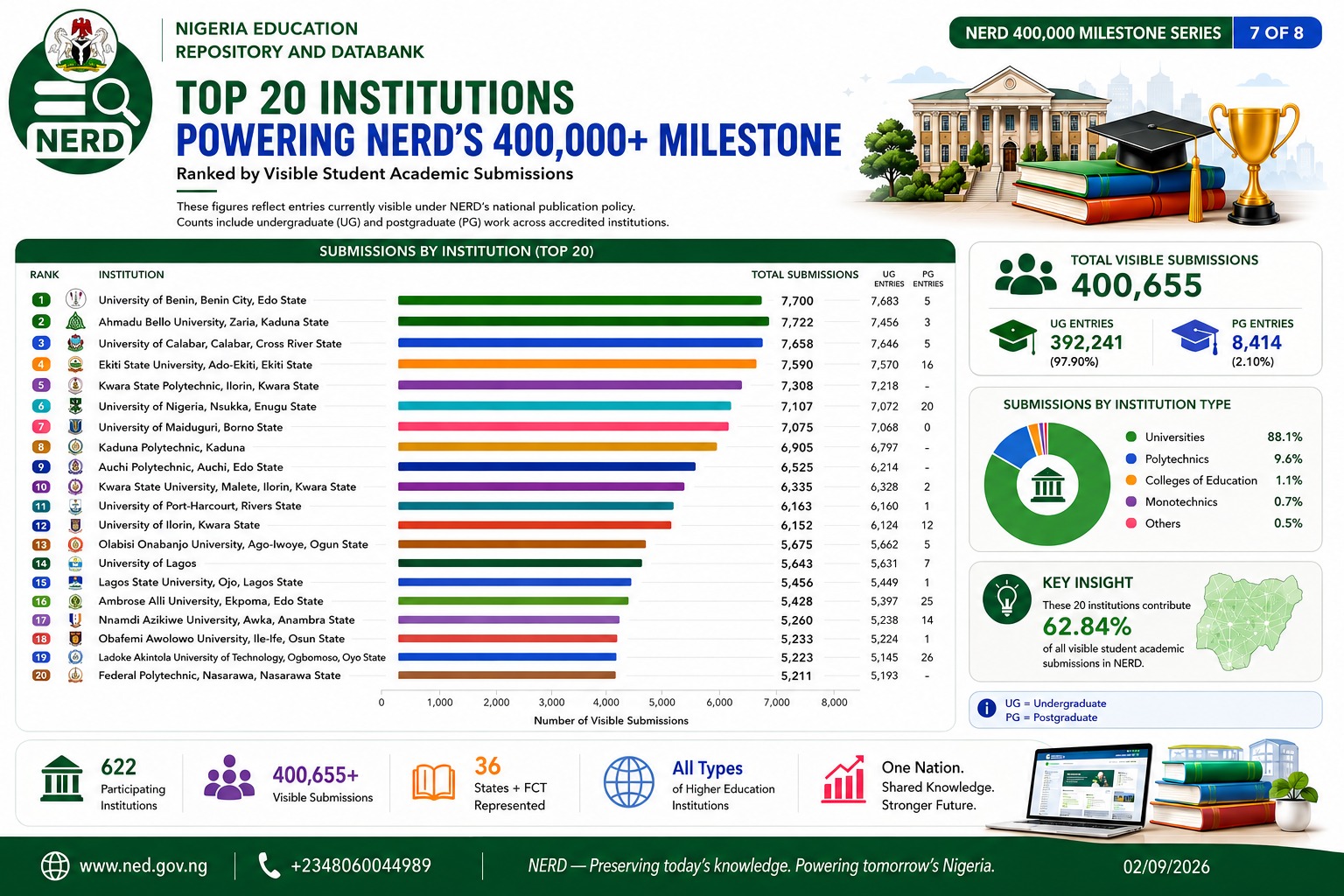
Nigeria’s drive to establish a national digital infrastructure for education records and quality assurance in higher institutions has reached a major milestone, with the Nigeria Education Repository and Databank (NERD) recording more than 400,000 digitised theses, dissertations and other academic works.
Education officials and stakeholders regard the development as a significant step towards preserving Nigeria’s intellectual output, improving access to local research and establishing a national database for the instant validation of academic credentials.
Data from the repository showed that by early September 2026, the platform had accumulated more than 400,000 visible academic submissions from universities, polytechnics, monotechnics, colleges of education and other post-secondary institutions across the country.
The figure had risen above 410,000 as of press time.
Similarly, the National Credential Verification Service component of NERD has verified more than 115,000 academic credentials and assigned them National Credential Numbers (NCNs), fulfilling a key mandate of the initiative to authenticate, preserve and digitally warehouse academic qualifications.
The milestone represents one of the measurable outcomes of the Federal Government’s Renewed Hope Agenda and its ongoing education digitisation programme under President Bola Ahmed Tinubu, GCFR, whose administration has increasingly prioritised technology, data and institutional accountability in education reforms.
Under the supervision of the Minister of Education, Dr Tunji Alausa, CON, NERD has expanded into a broad national infrastructure connecting institutions, students, academic works, workers and credentials within a common digital environment.

629 Institutions Active on Repository
The level of institutional participation is also significant.
Figures on the NERD platform show that 907 institutions have enrolled, with 629 currently active, highlighting the expanding reach of the national repository across various categories of post-secondary institutions.
The latest institutional breakdown includes 259 universities, 163 polytechnics, 179 monotechnics, 178 colleges of education and 130 institutions under other categories.
The digital network also covers 2,020 enrolled faculties, of which 1,620 have visible submissions. In addition, 5,353 out of 9,626 enrolled departments have visible academic works on the repository.
The figures indicate that the challenge is gradually shifting from getting institutions onto the national platform to increasing participation across individual faculties and departments.
Universities, Polytechnics Battle for Top Spots
Competition among institutions is increasingly visible in the repository’s national statistics.
The latest Top 20 ranking places the University of Benin and Ahmadu Bello University, Zaria, at the forefront of a closely contested group, followed by Ekiti State University, the University of Calabar and the University of Nigeria, Nsukka, among other leading contributors.
The rankings are particularly notable for the strong performance of polytechnics alongside universities.
Kwara State Polytechnic, Kaduna Polytechnic, Auchi Polytechnic, Federal Polytechnic Nasarawa and Federal Polytechnic Nekede are among institutions contributing substantial volumes of student academic works.
At faculty level, the Faculty of Education at Ahmadu Bello University currently leads the chart, while Education at Ekiti State University and Science and Technology at Kaduna Polytechnic also rank among the leading contributors.
Departmental statistics present an even more diverse picture, with Mass Communication and Public Administration departments from several polytechnics occupying some of the top positions.
This demonstrates that Nigeria’s expanding digital research collection is not being driven solely by the traditional university system.
Projects Dominate National Academic Collection
The repository’s data also provide insight into the composition of the materials being preserved.
Student projects make up the largest category of visible academic works, while theses, dissertations, seminar papers and other research outputs account for smaller portions of the collection.
As of September 4, 2026, undergraduate submissions stood at 409,456, significantly higher than the 1,563 postgraduate submissions recorded.
The importance of the initiative extends beyond the number of documents collected.
For decades, Nigerian universities and other tertiary institutions produced large volumes of theses, dissertations, projects and scholarly materials that were largely kept in departmental libraries, physical archives or disconnected institutional systems.
As a result, valuable research was often difficult to access outside the institutions where it was produced.
The establishment of NERD by the Tinubu administration is an effort to change that pattern by creating a structured national platform through which academic output can be verified, preserved, indexed and progressively made discoverable.
Women Lead in Research Submissions
Fresh NERD statistics also reveal a notable gender dimension to Nigeria’s emerging academic knowledge base, with female students currently accounting for a larger share of visible research submissions than their male counterparts.
Of the records categorised by sex, 228,347 submissions were attributed to female students, compared with 181,536 from male students, while 77 records were not categorised.
The pattern broadly corresponds with the platform’s overall student enrolment figures, which show 248,284 enrolled female students against 197,526 males.
The age profile provides another insight into the demographic character of the growing repository. The largest concentration of final-year or graduating students falls within the 25–29 age bracket, followed by those aged 20–24, with considerably smaller numbers recorded in older age categories.
Taken together, the figures provide an expanding national-level dataset that could help government, institutions and researchers better understand participation patterns within Nigeria’s tertiary education system.
Industry Focus and Top Knowledge Pillars
The data also reveal a notable trend: students across disciplines are increasingly gravitating towards innovation- and technology-driven research topics.
The trend is not limited to science, technology and engineering disciplines.
It is also becoming increasingly evident in the social sciences, humanities, law and other fields, pointing to a broader shift towards research that incorporates technology, innovation and practical problem-solving.
From Certificates to National Knowledge Infrastructure
NERD’s academic credential verification component gives the initiative an additional strategic dimension.
With more than 115,000 academic credentials verified and assigned unique National Credential Numbers, the emerging infrastructure provides a common national framework for identifying, referencing and authenticating academic credentials.
At the same time, NERD is preserving and organising research and intellectual outputs generated across Nigeria’s education system.
The combination of knowledge preservation and credential authentication could become important to the Federal Government’s broader effort to modernise education administration and strengthen the integrity of academic records.
The milestone also comes as the Tinubu administration seeks to reposition education as a tool for skills development, innovation and economic growth.
The Ministry of Education under Alausa has increasingly focused on reforms designed to connect education more closely with technology, employability, research and national development.
NERD now provides a measurable digital component to that policy direction.
Rather than leaving Nigeria’s academic heritage scattered across hundreds of institutions, the country is gradually assembling a national body of knowledge that can be counted, verified, organised and analysed.
A Repository Still Growing
The statistics remain dynamic, with institutional participation and submission volumes continuing to change as more records are uploaded.
Consequently, current institutional rankings could change as digitisation efforts accelerate.
That dynamism could become one of the strengths of the project. Universities, polytechnics and colleges can increasingly track their contributions to the national research pool, while policymakers gain a broader understanding of where academic work is being produced and where participation remains limited.
Crossing the 400,000 mark, therefore, is less an endpoint than evidence of the scale already achieved.
For the Federal Government, the milestone demonstrates that a nationwide education repository can move from policy conception to measurable infrastructure. For institutions, it offers an opportunity to give decades of Nigerian scholarship greater visibility.
For students and researchers, it creates the prospect that academic work produced in Nigeria will increasingly become part of a permanent and organised national intellectual record.
The bigger test, however, will be how effectively the expanding body of knowledge is connected to research, industry, innovation and public policy.
This is why attention is also focused on what Alausa and his team are doing with the introduction of the National Laureate Programme, an initiative aimed at building on the Tinubu administration’s achievements with NERD by helping to move promising academic discoveries and research outputs towards commercially viable products and services.
The programme also seeks to improve visibility for young researchers and their work while identifying, celebrating and rewarding research with strong potential for real-world application.
With more than 410,000 academic works, over 115,000 verified credentials and 629 active institutions already within the emerging ecosystem, Nigeria appears to have crossed an important threshold—from discussing the need to preserve its academic knowledge to actually building the infrastructure required to do so.
dates