
Legislature
Nigerian Senate Considers Legislation to Create Multiple Funding for Nigeria Police Passes the police trust fund bill to second reading

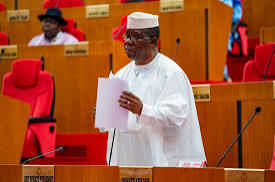
The Senate, Thursday, considered a bill to repeal and re-enact the Nigeria Police Trust Fund (Establishment) Act, 2019 aimed at creating multiple funding sources for the police to address chronic challenges that undermined its operational capacity.
The bill, according to the upper chamber, proposed one percent of total revenue accruing to the Federation Account for the police; allocated development levies under relevant tax laws; grants and interventions from federal, state, and local governments; donations and international support from bilateral and multilateral partners and private sector contributions and endowments.
Leader of the Senate, Senator Opeyemi Bamidele highlighted these proposals in his lead debate on the imperatives of amending the legislation, thus calling for a more effective legal framework for the funding, administration, and operational support of the police establishment.
The Nigeria Police had faced acute and chronic funding deficit in 2026, a condition that contributed insecurity and limited the ability of officers to respond decisively to diverse security challenges that plagued the federation.
Despite billions funneled to the police operations annually, police formations had operated with minimal funds, relying on unofficial sources for daily operations amid infrastructure decay, operational shortfalls, weak logistics support, inadequate security equipment and dependence on external aid.
Sponsored by Bamidele, the bill sought to enhance the operational capacity, technological capability, infrastructure renewal of the police formations and ensure predictable and sustainable funding streams.
Leading debate on the bill on Tuesday, Bamidele argued that the proposed legislation would ensure operational independence within a clearly defined legal framework as well as sustainable and diversified funding sources.
Bamidele, therefore, justified the need to repeal and re-enact the bill, explaining that the existing legislation was a commendable initiative.
However, according to him, practical experience over the years has exposed gaps in the governance structure; funding sustainability; project execution mechanisms; and transparency and accountability frameworks.
He said: “Accordingly, rather than embarking on piecemeal amendments, this Bill proposes a comprehensive repeal and re-enactment to align its provisions with current realities, global best practices, and Nigeria’s security priorities. ”
“Sources of funding proposed by Bamidele in the bill include: one percent of total revenue accruing to the Federation Account; development levies allocated under relevant tax laws; grants and interventions from federal, state, and local governments; donations and international support from bilateral and multilateral partners; and private sector contributions and endowments.”
He explained that a diversified funding model would no doubt guarantee sustainability and reduce over-reliance on annual budgetary allocations.
Bamidele outlined prioritised areas of interventions to include acquisition of modern security equipment and operational tools; deployment of digital surveillance systems and forensic technology; construction and rehabilitation of police stations and facilities; strengthening of training institutions and capacity building programmes, among others.
He further explained that the bill, when duly enacted, enhance intelligence gathering and operational efficiency; provide for emergency response during internal security crises as well as improve welfare packages for officers and personnel.
Bamidele also called for the establishment of a governance and institutional framework for the trust fund, including a robust governing board composed of key stakeholders: a chairman who is a retired senior police officer; representatives of relevant ministries – Police Affairs, Justice, and Finance; a representative of the Police hierarchy; and a representative of the organised private sector.
Supporting the bill, Minority Leader of the Senate, Senator Abba Moro threw his weight in support of the bill, noting that the trust fund was originally established to address the inadequate funding of the Nigeria Police Force.
Moro noted that police formations lacked the modern equipment required to effectively combat kidnapping nationwide.
He said: “You will recall that one of the problem associated with policing in Nigeria which necessitated passage of the Police Trust Fund, I think time has come to confront problem of funding confronting security agencies especially police
“When you report cases of abduction, they will tell you they cannot go because the abductors have more superior firearms,” the minority leader justified his support for the proposed legislation.
Deputy President of the Senate, Senator Jubril I. Barau supported the bill, citing its significance for the security and stability of the federation.
He said the Nigeria Police “is for the Federal Republic of Nigeria. It is not only serving the federal government, but also the entire federation. What the bill is talking about is in tandem with our constitution. There is no better time to pass the bill than now.
However, Senator Ibrahim Dankwambo warned that a proposed one per cent deduction could render the bill null and void if challenged in court, recalling that a similar arrangement had previously been set aside following opposition from state governors.
He also questioned how funding for the federal police would be harmonised with ongoing discussions around the creation of state police.
Also, in his contribution, Senator Buhari Abdulfatai argued that the core problem facing the police was not necessarily the volume of funding, but the lack of adequate tools and operational support.
He noted that Nigeria currently “has about 300,000 police officers serving a population of over 200 million,” which according to him, was inadequate by the global standard.
Following extensive debates on the bill, President of the Senate, Senator Godswill Akpabio put the bill to a voice vote, with the majority of the lawmaking chorusing their support for the proposed legislation.
He noted that a public hearing would address lingering concerns, including accountability for previous Police Trust Fund expenditures, alternative sources of funding, and whether the proposed framework would accommodate state policing structures.
Akpabio also directed the Senate Committee on Police Affairs to brief the leadership on how past trust fund allocations were utilised.
The senate consequently referred the bill to the Senate Committee on Police Affairs chaired Sen. Ahmed Mallam-Madori, directing the committee to report the plenary in two weeks.