
Opinion
The Antelope That Stands Like a Man to Eat

_By Sam Agogo_
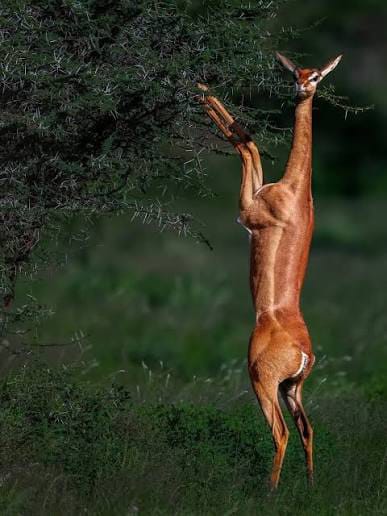
In the thornbush country of East Africa, where acacia trees rise too tall for most grazers to reach, one antelope has solved the problem in a way no other hoofed animal has managed. Known locally as the giraffe gazelle and scientifically as Litocranius walleri, the gerenuk stretches its long neck skyward, rises onto its hind legs, braces its forelegs against branches, and browses the canopy like a creature standing upright by choice. Its Somali name, “gerenuk,” fittingly means “giraffe-necked.”Unlike the impala or Thomson’s gazelle, the gerenuk is rare and distinct, the only member of its genus. Its closest lookalike is Somalia’s dibatag, though the two remain genetically unconfirmed as relatives.
Everything about the gerenuk’s build—slender legs, elongated neck, delicate head, and wide eyes—reflects a single evolutionary gamble: survival through reach rather than speed or strength. Standing upright, it can browse leaves over two metres high, a feat no other antelope can match.The gerenuk is a specialist, a connoisseur of thornbush cuisine.

It feeds on more than 80 plant species, delicately plucking buds, shoots, and flowers from acacia and other thorny vegetation.
Its long upper lip and pointed mouth work with surgical precision, avoiding spines that would deter less careful eaters. Even more remarkable is its relationship with water.
The gerenuk rarely drinks at all, extracting nearly all the moisture it needs from plants.

Its kidneys are engineered to concentrate urine, and its nasal passages minimise moisture loss through breathing.
In a land where drought is a constant threat, this adaptation is nothing short of genius.Socially, the gerenuk is a creature of distance. It lives alone or in small groups of two to six, usually divided by sex. Larger gatherings are rare and fleeting, formed only when food is briefly abundant.
Even bonds between mother and calf are short-lived, ending when the next offspring arrives. Males are solitary rulers of small territories, three to six square kilometres in size, marked with scent from glands near their eyes. They defend these ranges not through bloody combat but through ritualised clashes—horns locked, heads lowered to protect their vulnerable necks.
More often, they vent aggression by “shrub horning,” attacking bushes in displays of dominance.Breeding has no season for the gerenuk. Courtship is a ritualised dance: the male taps the female’s flanks with his foreleg, marks her thigh with scent, and tests her readiness with a lip-curling flehmen response.
If she accepts, the bond is brief but purposeful. After seven months, a female gives birth to a single calf. She hides it in dense cover, returning only at dawn and dusk to nurse, carefully cleaning away any trace of scent that might betray its presence to predators.
Even in captivity, hand-reared fawns mimic the adult feeding posture within two weeks, a sign of how deeply ingrained this adaptation is.
By one year, calves are independent; young males drift into bachelor groups until strong enough to claim territory.The gerenuk is not built for speed. Lions, leopards, cheetahs, hyenas, and wild dogs all hunt it, and its defence is stealth. It freezes behind cover, using its long neck to peer over bushes without exposing itself.
When it moves, it favours a crouched trot or stiff-legged gait, breaking into a gallop only as a last resort. Even then, it cannot match the speed of a springbok or Thomson’s gazelle. Its survival strategy is patience, caution, and invisibility.
The gerenuk’s range stretches across Djibouti, Ethiopia, Somalia, Kenya, and northeastern Tanzania. But this range is patchy, fragmented, and shrinking.
Fewer than 100,000 remain in the wild, and numbers are falling. Habitat loss, bushmeat hunting, and human encroachment are erasing the thornbush landscapes it depends on. Listed as Near Threatened since 2008, many researchers argue this status is outdated. Evidence points to a decline of at least 25% in the past two decades.
In some areas, such as Tanzania’s Simanjiro plains, the gerenuk is already locally extinct.There are pockets of resilience.
In Kenya’s Samburu and Meru regions, sightings are reliable enough that safari operators treat the gerenuk as a signature species.
Populations persist in Amboseli, Lewa, Tsavo, and Ethiopia’s Geralle National Park. But these protected areas cover only a fraction of its true range. Outside those boundaries, the future is far less assured.The gerenuk is not a headline species.
It does not command the sweeping numbers of elephants or the fierce charisma of lions. Its story is quieter, stranger, more architectural. It is an antelope that chose reach over speed, stealth over strength, solitude over herds. Its uniqueness is its vulnerability.
The very adaptation that makes it extraordinary ties it to a habitat that is disappearing. Extinction for such a species does not arrive with drama—it arrives quietly, in the slow disappearance of bushes and waterholes, until the world it was built for no longer exists.
The gerenuk, standing upright in the thornbush, reaching for leaves no other antelope can touch, is a reminder of nature’s inventiveness and fragility.
It is a case for protection, not because it is abundant, but because it is irreplaceable.
Its story is one of survival against odds, of elegance born from necessity, and of a future that hangs in the balance.
To lose the gerenuk would be to lose a chapter of Africa’s evolutionary imagination—a creature that solved a problem no other antelope dared to attempt.For reflections and conversation, reach me at:
samuelagogo4one@yahoo.com or call +2348055847364.