
Education
Uzodimma Challenges FUTO, Nigerian Universities to Lead Africa’s Fourth Industrial Revolution

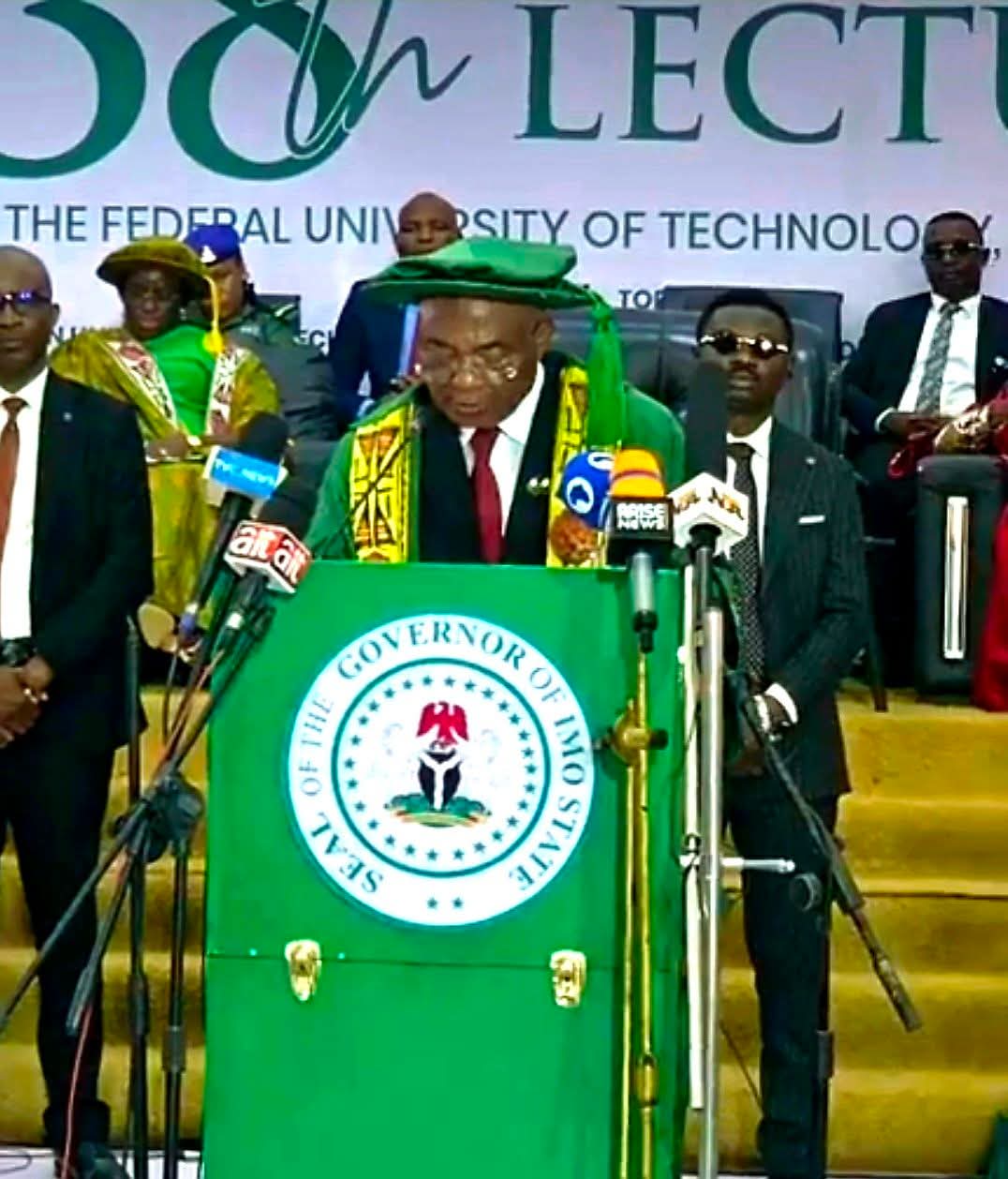
FUTO 38TH CONVOCATION LECTURE
Governor Hope Uzodimma has challenged Nigerian universities of science and technology, especially the Federal University of Technology, Owerri (FUTO), to take the lead in preparing the nation for the Fourth Industrial Revolution or risk leaving future generations economically irrelevant.
Delivering the 38th Convocation Lecture of FUTO, Governor Uzodimma warned that failure to embrace emerging technologies could undermine Nigeria’s future competitiveness and technological advancement.
Speaking on the theme, “Nigerian Universities of Technology Must Lead in the Fourth Industrial Revolution or Jeopardize the Nation’s Future,” the governor noted that Nigeria and Africa missed the first three industrial revolutions and cannot afford to miss the current technology-driven transformation powered by artificial intelligence, robotics, biotechnology, and digital innovation.
He urged universities to move beyond their traditional roles of teaching and research to become active drivers of innovation, industrial growth, and economic transformation.
Governor Uzodimma emphasized the need for sustained investment in Science, Technology, Engineering and Mathematics (STEM) education, describing it as essential to Nigeria’s quest for industrial growth and technological self-reliance.
According to him, while the Fourth Industrial Revolution presents enormous opportunities for economic growth and job creation, countries that fail to prepare their workforce and institutions risk being left behind in the global knowledge economy.

He stressed that Nigerian universities must position themselves at the forefront of technological development by producing graduates equipped with the skills needed to thrive in an increasingly digital world.
The governor also called for university curricula to be aligned with current industry realities and emerging technological trends, noting that such reforms would enable graduates to develop practical solutions to local and global challenges while improving their employability and entrepreneurial capacity.
He urged universities to strengthen partnerships with industry players, technology companies, government agencies, and research institutions to create innovation ecosystems capable of driving sustainable development.
Governor Uzodimma further encouraged research and development efforts targeted at addressing Nigeria’s unique socio-economic challenges rather than relying solely on imported technologies.
He cautioned that institutions and countries that fail to embrace technologies shaping the Fourth Industrial Revolution could face economic stagnation and increasing marginalization in the global marketplace.
Calling on policymakers, university administrators, lecturers, and students to embrace innovation and technological advancement, he noted that the stakes are particularly high for Nigeria because of its youthful population and growing demand for employment opportunities.
The governor described FUTO as a strategic institution with a historic mandate to drive technological advancement, adding that the university stands at a critical stage as it transitions to a new leadership.
He urged universities of technology to reform their curricula, strengthen industry partnerships, promote commercially viable research, and establish innovation hubs capable of producing globally competitive entrepreneurs and technology firms.
Drawing examples from countries such as South Korea, Singapore, Estonia, Rwanda, and India, where universities have become engines of economic transformation through innovation-driven education, Uzodimma said Nigerian institutions can achieve similar results.
He warned that failure to adapt to changing technological realities would worsen unemployment, brain drain, and economic marginalization as emerging technologies continue to reshape global labour markets.
Governor Uzodimma also pledged the support of the Imo State Government toward the development of a technology and innovation ecosystem around FUTO, including start-up incubation, research commercialization, and industry collaboration
According to him, FUTO has the opportunity not only to teach the Fourth Industrial Revolution but also to help Nigeria lead it.
He challenged universities to play a more strategic role in promoting innovation, entrepreneurship, technological advancement, and economic development, stressing that higher institutions must become catalysts for solving societal problems and creating sustainable economic opportunities.
The governor noted that Nigeria’s future prosperity depends largely on its ability to harness knowledge, technology, and innovation to address challenges in unemployment, industrialization, agriculture, healthcare, infrastructure, and digital transformation.
He emphasized that universities occupy a unique position in national development because they produce the skilled manpower and research outputs required to drive economic growth and global competitiveness.
Uzodimma therefore encouraged institutions, particularly FUTO, to focus on generating practical solutions through research and innovation, adding that research outcomes should be transformed into commercially viable products, services, and technologies that improve lives and stimulate economic growth.
He also called for stronger collaboration between universities, industry stakeholders, and government agencies, noting that many groundbreaking ideas developed in Nigerian universities fail to reach the marketplace because of weak linkages between researchers and industry.
To address this challenge, he advocated the creation of robust innovation ecosystems that support technology transfer, start-up incubation, entrepreneurship, and commercialization of research outputs.
Addressing the graduating students, Governor Uzodimma urged them to embrace innovation and entrepreneurship as pathways to personal and national development. He advised them to develop problem-solving skills and entrepreneurial mindsets that would enable them to create jobs rather than depend solely on conventional employment opportunities.
He further stressed the need for universities to continuously update their curricula to equip students with relevant skills in artificial intelligence, digital technologies, data science, robotics, and other fields associated with the Fourth Industrial Revolution.
The governor commended FUTO for its longstanding contributions to technological education and human capital development, describing the institution as one of Nigeria’s foremost centres of excellence in science and technology.
He acknowledged the achievements of the university’s graduates across various sectors of the economy and reaffirmed his administration’s commitment to education and youth empowerment through policies that encourage innovation, digital skills development, enterprise creation, and economic inclusion.
Congratulating the graduating students, Governor Uzodimma urged them to uphold the values of excellence, integrity, hard work, and service to humanity, reminding them that graduation marks the beginning of a new phase of responsibility and opportunity.
He expressed confidence that FUTO would continue to play a pivotal role in shaping Nigeria’s technological future.
Earlier in her remarks, the Vice Chancellor of FUTO, Professor Nnenna N. Oti, described Governor Uzodimma as the most qualified person to deliver the institution’s 38th Convocation Lecture.
Professor Oti said the university deliberately reserved the lecture as the highlight of the convocation ceremony in honour of the governor, noting that neither the university nor its governing council could have chosen a more qualified and distinguished lecturer.
She added that the theme of the lecture aligns with Governor Uzodimma’s vision for technological advancement and development.
To God be the glory.
©OguB 2026®