
General News
GOCOP Embraces AI to Drive Efficiency and Profitability in Newsrooms

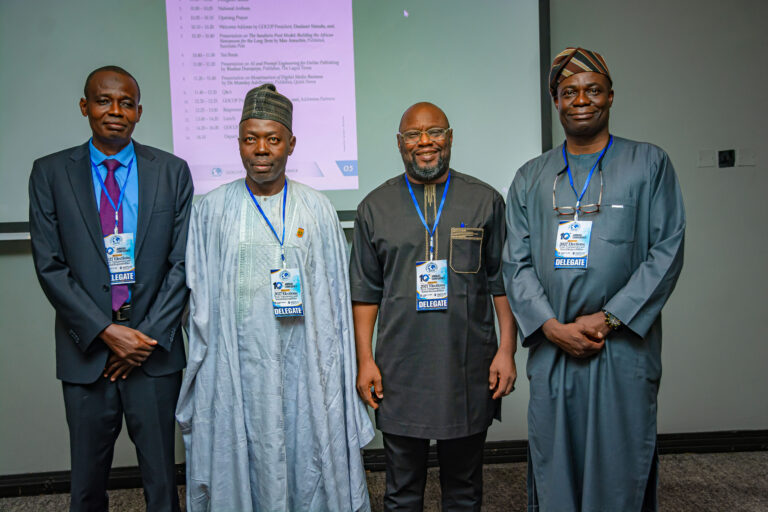
The Guild of Corporate Online Publishers (GOCOP) has organised a training session for its members on the effective deployment of Artificial Intelligence (AI) tools as part of measures to help them publish faster, better and more professionally while increasing profitability.
The training was held on the sidelines of the Guild’s 10th Annual Conference, taking place from October 8-9, 2026, at the Radisson Blu Hotel, GRA, Ikeja, Lagos, with the theme: “2027 Elections: Trust, Transparency and Shared Responsibilities.”
The training session, anchored by AI expert and Publisher of The Lagos Times, Sulaimon Durojaiye, was titled “The AI-Powered Newsroom: AI & Prompt Engineering for Online Publishing.” It explored how participants could publish faster, better and more profitably in the age of AI.

Durojaiye defined AI as technology that enables computers to perform tasks that normally require human intelligence. He noted that publishing had changed over time from the traditional newsroom-newspaper-reader structure.
According to him, AI understands language, recognises patterns, analyses information, generates content, solves problems, makes predictions and assists decision-making. He stressed that one does not need to be a programmer to use AI.
He listed three AI terms every publisher should know, including Generative AI, which creates text, images, audio, video and code. He also identified Large Language Models (LLMs) as systems trained on enormous amounts of information that understand and generate human language, citing ChatGPT, Gemini, Claude and Copilot as examples.
Durojaiye also noted that AI is not Google Search Engine, explaining that while search engines find information, return links and sources, users must investigate and make decisions.
According to him, generative AI works with information, creates, transforms and analyses it, but could be wrong many times. He therefore stressed that users must verify every piece of information sourced from AI to avoid running into trouble.
He also took participants through the rudiments of what he described as “Enter Prompt Engineering,” which he defined as the art and science of giving AI clear instructions to produce useful results.
He differentiated a bad prompt, such as “write a story about the budget,” from a better prompt that could instruct AI to act as a senior Nigerian newspaper correspondent, analyse a supplied budget speech and write a 600-word news story, leading with the most significant development and using the inverted pyramid format in news writing.
He further listed the Five-Part Prompt Formula as Role, Task, Context, Requirements and Output, warning that better instructions would produce better results and vice versa.
On the AI newsroom, Durojaiye told participants that AI could be deployed for news gathering and research. It can analyse long speeches and reports, summarise government documents, extract key facts, compare documents, generate interview questions and identify story angles.
Other newsroom and research capabilities of AI, he said, include analysing datasets, researching background information, converting complex materials into plain English and assisting with investigations, while warning that AI does not replace investigation itself.
He listed other uses of AI across the publishing workflow, including news gathering, research, interviews, transcription, writing, editing, SEO, social media, newsletters and analytics, noting that AI is not just one tool but an entire workflow.
According to him, with the use of AI, one news event can become multiple content products, including news stories, features and explainers, profiles and interviews, opinion drafts, headlines and captions, newsletters and press-release transformations.
He added that while AI accelerates production, the journalist remains responsible for facts, context and news judgement.
Durojaiye also disclosed that AI could be used for Search Engine Optimisation (SEO), noting that publishers do not just need to publish but also need to ensure that their content can be found.
He said AI could assist with search-friendly headlines, SEO titles and meta descriptions, keywords and search intent, FAQs, content structures, internal-link suggestions and content clusters.
“The story isn’t finished when you publish it. It is finished when the right audience can find it,” he said.