International
China, African Leaders Deepen Cultural Ties as 2026 People-to-People Exchange Year Opens in Addis Ababa

By Iyojo Ameh
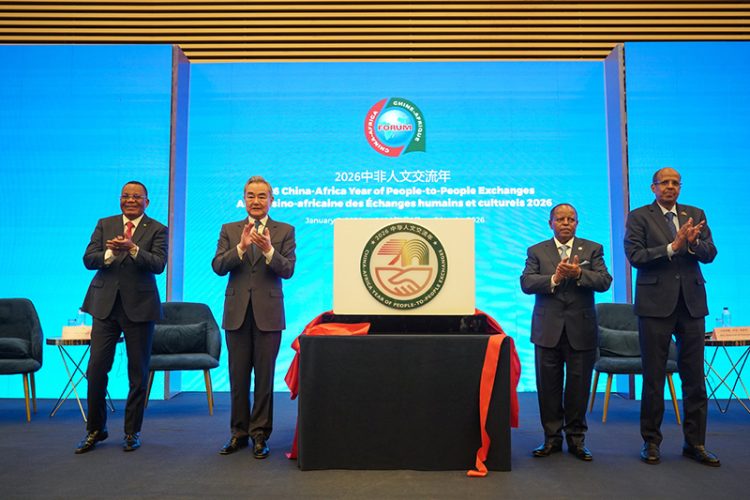
The 2026 China–Africa Year of People-to-People Exchanges was formally inaugurated on Thursday at the African Union (AU) headquarters in Addis Ababa, Ethiopia, with leaders from both sides calling for deeper dialogue, solidarity and cultural cooperation between the two civilizations.
The high-level ceremony drew more than 200 participants, including senior officials of the AU Commission and institutions, diplomats from African countries, representatives of United Nations agencies, and officials from various sectors of the Ethiopian government.
China’s Foreign Minister, Wang Yi, who is also a member of the Political Bureau of the Communist Party of China Central Committee, read a congratulatory letter from President Xi Jinping and delivered the keynote address.
He was joined by Jean-Claude Gakosso, Foreign Minister of the Republic of the Congo and African co-chair of the Forum on China-Africa Cooperation (FOCAC), AU Commission Chairperson Mahmoud Ali Youssouf, and Ethiopian President Taye Atske Selassie.
Wang said the launch of the China–Africa Year of People-to-People Exchanges was a major initiative jointly agreed upon by President Xi and African leaders, aimed at strengthening mutual understanding and cooperation beyond politics and trade.
In his message, President Xi stressed the importance of mutual learning among civilizations in advancing China–Africa modernization and outlined guiding principles for people-to-people and cultural cooperation.
Wang said the letter reflected deep thinking on human history and civilization and offered strategic direction for building an all-weather China–Africa community with a shared future in the new era.
He noted that China and Africa share a long history of friendship and that, under the guidance of leaders on both sides, people-to-people exchanges have expanded rapidly in recent years, yielding tangible results.
“People-to-people exchanges form the most solid foundation of China–Africa friendship, while mutual learning among civilizations is the strongest driving force of our cooperation,” Wang said.
The Chinese foreign minister also spoke on the shifting global order, noting that the world is undergoing profound changes unseen in a century, with the Global South, represented by China and Africa, rising steadily.
He warned that power politics and acts of bullying continue to undermine international law and the legitimate interests of developing countries.
Against this backdrop, Wang called on China and Africa to uphold fairness and justice, strengthen unity and mutual support, prioritize development, put people first, and embrace openness and inclusiveness.
African leaders at the event welcomed the initiative, describing it as a practical step toward implementing President Xi’s proposals and deepening Africa–China relations. They said the exchange year would open a new chapter in bilateral ties, enhance dialogue between civilizations, and strengthen bonds between the peoples.
They expressed readiness to deepen cooperation with China in culture, education, tourism, arts, youth exchanges and other areas, while reaffirming that Africa–China cooperation remains mutually beneficial.
The leaders also praised China’s long-standing tradition of making Africa the destination of its foreign minister’s first overseas visit each year, commended China’s development achievements, and thanked Beijing for its continued support and assistance.
Since the establishment of FOCAC, they noted, Africa and China have recorded significant progress in trade, infrastructure connectivity, agriculture, education and telecommunications, contributing to the implementation of the African Union’s development agenda.
The African side further expressed willingness to deepen cooperation under the FOCAC framework and the Belt and Road Initiative to achieve shared development goals.
In the face of growing global instability, African leaders also voiced support for the Global Governance Initiative proposed by President Xi, calling for joint opposition to hegemonism, defense of the international order, and collective efforts to safeguard world peace.