
General News
China Lifted 800 Million From Poverty: Nigeria Urged to Adapt Development Lessons

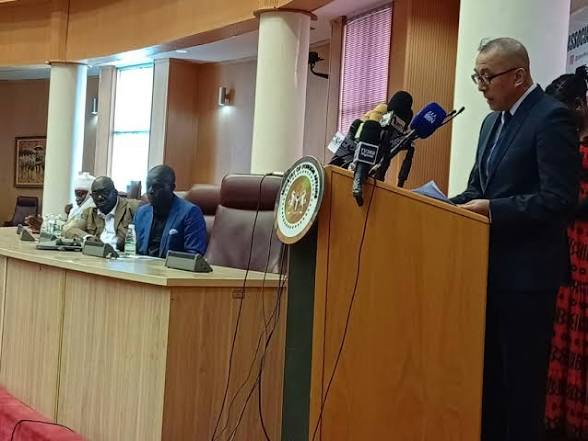
Stakeholders have called on Nigeria to study and adapt lessons from China’s poverty reduction experience as part of efforts to tackle the country’s persistent poverty and development challenges.
The call was made on Tuesday in Abuja at a one-day workshop on “Nigeria’s Poverty Alleviation and China’s Development Modules,” organised by the Diplomatic Correspondents’ Association of Nigeria (DICAN).
The workshop, themed “Nigeria’s Poverty Alleviation Efforts: Adopting China Modules and Its Relevance in a New Era — The Place of Policymakers, Development Partners and Diplomatic Reporters,” brought stakeholders together to examine how aspects of China’s development experience could be relevant to Nigeria.


Speaking at the event, the Chinese Ambassador to Nigeria, Yu Dunhai, said China had lifted more than 800 million people out of poverty since the commencement of its reform and opening-up programme in 1978.
Dunhai, represented by the Counsellor of the Economic and Commercial Office of the Chinese Embassy, Sun Xuekun, said China’s achievement accounted for more than 70 per cent of global poverty reduction.
He said the country’s progress was particularly significant given that nearly 100 million rural residents were still living below the poverty line at the end of 2012, but had been lifted out of poverty by the end of 2020.

“On average, more than 12 million people escaped poverty each year, equivalent to the population of a medium-sized country,” he said.
According to the envoy, China also lifted 98.99 million rural poor residents, 832 impoverished counties and 128,000 impoverished villages out of poverty.
He attributed the achievement to strong political commitment, targeted interventions, economic development, infrastructure investment and mechanisms designed to prevent people from falling back into poverty.
Dunhai said the Chinese government invested nearly 1.6 trillion yuan in special poverty alleviation funds and deployed more than three million officials and village work team members to establish a nationwide assistance network.
He explained that China moved from broad-based interventions to a more targeted system that identified poor households, assessed the causes of poverty and matched interventions with specific needs.
The strategy, he said, included local industry development, relocation of communities from inhospitable areas, ecological compensation, educational assistance and strengthened social security.
It was also supported by investments in roads, water supply, electricity, telecommunications, education and healthcare.
Dunhai said China’s experience demonstrated that poverty could be addressed through sustained economic and social development, noting that the country had subsequently linked poverty reduction with its rural revitalisation strategy to consolidate the gains achieved.
China’s Zero-Tariff Policy
The Chinese envoy also urged Nigeria to take advantage of China’s zero-tariff policy for African exports by strengthening local supply chains, improving product standards and expanding non-oil exports to the Chinese market.
He said greater access to the Chinese market could create opportunities for African producers, provided countries such as Nigeria improved their capacity to produce goods that meet international standards.
Journalists Have Role to Play
Dunhai also highlighted the role of journalists in development, saying the media should not merely observe government policies but should document progress, expose shortcomings and help citizens understand the impact of government and international development initiatives.
The workshop further emphasised the importance of reliable data, accountable institutions, human-capital development and sustained investment in infrastructure in Nigeria’s fight against poverty.
Participants, however, stressed that Nigeria should not simply replicate China’s model but adapt relevant aspects to the country’s own economic, social, political and institutional realities.
They said lessons from China could be useful if combined with stronger domestic institutions, effective implementation mechanisms and policies tailored to Nigeria’s specific development challenges.