
News
Is the Hausa-Fulani Bloc Crumbling under the Weight of History and Insecurity?

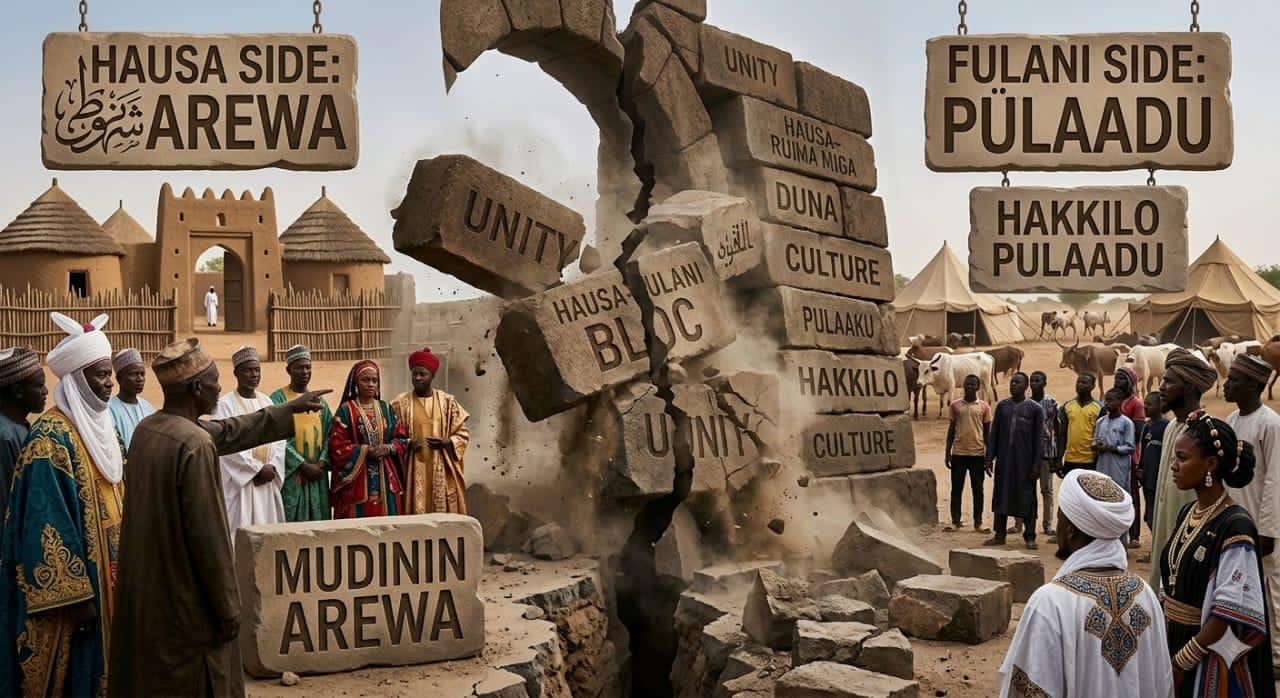
By Sam Agogo
The question of whether the Hausa are separating from the Fulani has become one of the most pressing debates in Northern Nigeria today. What was once whispered in corners has now grown into a loud, emotionally charged discourse across markets, villages, and social media platforms. The identity of “Hausa-Fulani,” long assumed to be a unified reality, is being openly questioned, resisted, and in some cases rejected. To understand this moment, one must revisit the long and complex history that binds—and divides—these two peoples.
The Hausa are among West Africa’s oldest settled civilizations, known for their city-states such as Kano, Katsina, Zaria, and Gobir. They were traders, farmers, and rulers of organized kingdoms centuries before colonial intrusion. The Fulani, by contrast, were traditionally pastoralists—nomadic cattle herders spread across the Sahel. Their interaction with Hausa communities began gradually through trade, migration, and settlement. But the defining turning point came with the Sokoto Jihad of 1804, led by the Islamic scholar Usman dan Fodio. What began as a religious reform movement against corruption and un-Islamic practices in Hausa kingdoms quickly transformed into a full-scale revolution. By 1808, much of Hausaland had fallen under Fulani control, leading to the establishment of the Sokoto Caliphate—one of Africa’s largest empires. Fulani emirs were installed across Hausa territories, creating a new political order that fused Islamic governance with Fulani leadership over largely Hausa populations. From this conquest, the “Hausa-Fulani” identity began to take root—not as an ethnic reality, but as a political convenience.

British colonial authorities later reinforced this arrangement. Rather than dismantle the caliphate system, they ruled Northern Nigeria through Fulani-led emirates, strengthening the perception of a unified Hausa-Fulani bloc. Over time, this identity became embedded in Nigeria’s political language, especially in contrast to other major groups like the Yoruba and Igbo. Yet beneath this constructed unity, ethnic distinctions remained clear: Hausa identity rooted in language and culture, Fulani identity in lineage, pastoral heritage, and aristocratic dominance.
In post-independence Nigeria, the Hausa-Fulani identity became a powerful political tool, projecting numerical strength and ideological unity. But critics argue that this unity disproportionately favored Fulani elites, particularly in traditional institutions and political leadership. The Sultan of Sokoto remains one of the most influential authorities in the North, yet Hausa voices increasingly question whether such institutions truly represent indigenous interests.
The current wave of insecurity has brought these tensions to the surface. Banditry, kidnappings, and rural violence have devastated farming communities, predominantly Hausa, in states like Zamfara, Katsina, Sokoto, and Kaduna. Many of these attacks are attributed to armed groups identified as Fulani militias, fueling a dangerous narrative of Hausa victims versus Fulani perpetrators. Whether oversimplified or not, perception has hardened into reality, deepening resentment and suspicion.

In response, new movements have emerged, calling for a distinct Hausa identity separate from Fulani political structures. They argue that the Hausa were conquered, not merged, that Fulani dominance in emirates is a legacy of conquest rather than consent, and that modern governance must reflect indigenous representation. Some even demand reforms—or outright restructuring—of institutions rooted in the caliphate system. This marks a significant shift from quiet acceptance to vocal resistance.
Yet the situation is far from straightforward. For over two centuries, Hausa and Fulani communities have lived side by side, intermarrying, sharing language, and practicing Islam together. In many cases, the distinction between Hausa and Fulani is blurred, with millions identifying as both. Islam remains a powerful unifying force that transcends ethnic boundaries. Even among critics of the Hausa-Fulani identity, there is no consensus on separation, and some warn that pushing ethnic division could ignite deeper conflict in an already fragile region.
The reality is nuanced. What is unfolding is not a complete ethnic separation, but a reawakening of identity and a protest against perceived injustice. It is a rejection of imposed political labels, a demand for accountability in the face of insecurity, and a call for fair representation in both traditional and modern institutions. But it is not yet a total social or cultural divorce.
This moment carries both risk and opportunity. Rising rhetoric could fracture communities and destabilize the North, but it could also spark overdue reforms, correcting historical imbalances and building a fairer society. The Hausa and Fulani share more than history—they share a future. Whether that future is defined by conflict or cooperation depends on how today’s tensions are managed. The real question is not whether the Hausa are separating from the Fulani, but whether Northern Nigeria can redefine unity in a way that is just, truthful, and sustainable.
For comments, reflections, and further conversation, email: samuelagogo4one@yahoo.com