
News
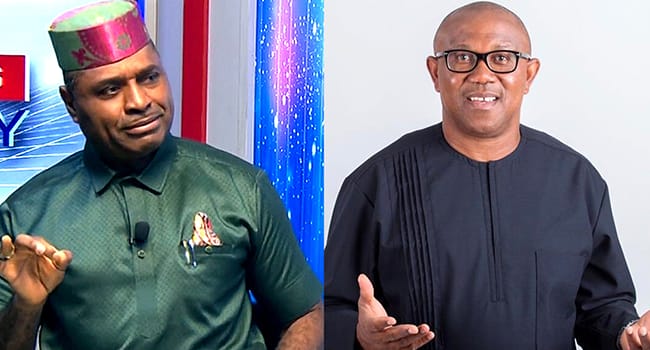
WHAT DOES KENNETH OKONKWO WANT FROM PETER OBI THAT DECENCY WILL NOT ALLOW HIM TO SAY?

_By Sam Agogo_
Let us begin where all great deceptions must eventually end — with the truth.
In the theatre of Nigerian politics, where lies are currency and character assassination passes for debate, few allegations have been as deliberately malicious and as spectacularly false as the claim that former Anambra State Governor and Labour Party presidential candidate Peter Gregory Obi graduated with a Third Class degree. This lie was not whispered by strangers. It was amplified and weaponised by a man who once stood shoulder to shoulder with Obi on campaign platforms, defended him on national television with fire and eloquence, and staked his own reputation on Obi’s integrity. That man is Kenneth Okonkwo — actor, lawyer, pastor, failed politician, and now the most bitter critic of the very movement that gave him his last meaningful moment in the national spotlight.
The facts are not in dispute. Peter Obi’s degree certificate, publicly verified, shows he graduated with Second Class Honours, Lower Division, from the University of Nigeria, Nsukka in 1984, where he studied Philosophy. He subsequently attended the Lagos Business School, Harvard Business School, and Cambridge Judge Business School — institutions that do not open their doors to men of mediocre intellect. That Okonkwo, a trained lawyer who understands the gravity of false allegations, would peddle this lie repeatedly says everything about the man making the claim and nothing about its target.
But the degree allegation is only the beginning. The catalogue of words Okonkwo has unleashed against Peter Obi reads less like political criticism and more like the journal of a deeply wounded man. He called Obi’s millions of supporters “classless street urchins” and “rabies-infected dogs — ill-bred, very ill-mannered.” He branded Obi a “politician of convenience” who “runs away from challenges,” declared his temperament “incompatible with the requirements of Nigeria today,” and sneered publicly, “You want to project that it’s only you that can be President — who are you?” He accused Obi of lacking the traits of “a team player and an effective manager,” claimed Obi was “committing political suicide,” and asserted that “by nature, chaos follows him.” He went further, accusing Obi of “bringing toxicity into the ADC,” building “his political career on sand,” and being “possessed with an entitlement mentality.” And with the dramatic flourish only a Nollywood veteran could deliver, he declared on national television: “If there is anybody that betrayed the other, I can say it emphatically — Peter Obi betrayed me.”
Peter Obi’s response to all of this was instructive. He did not match insult with insult. He simply said: “I have never and will never look down on anyone, except to lift them up. No Nigerian is a street urchin.” He even urged his supporters not to attack Okonkwo, calling him “a beloved brother and a trusted ally.” One man responded to a public war with private dignity. The other mistook the microphone for a machete.
There is a wound in all of this that goes beyond politics. Okonkwo and Obi are both Igbo sons of the South-East — brothers in blood, culture, and language, from the same region, the same struggles, the same history of marginalisation in a country that has never fully embraced their people. That shared identity should count for something. That it apparently counts for nothing in Okonkwo’s political calculations is what makes this story not just sad, but deeply troubling.
Consider what happens in the North. When northern politicians fall out — and they do, fiercely and frequently — they fight their battles through back channels, closed-door negotiations, and quiet realignments. A northern politician, regardless of how deeply he feels wronged by a kinsman, understands instinctively that publicly destroying one of your own is an act of collective self-harm. He knows that the moment he picks up the megaphone to humiliate his brother before a national audience, he has not just wounded that brother — he has handed a weapon to every enemy of his people. That discipline, that unspoken code of solidarity, is not weakness. It is wisdom. It is precisely why, decade after decade, the North has produced Nigeria’s presidents, controlled its institutions, and shaped its destiny. They protect their own — even when they despise them privately.
The Yoruba, too, understand this calculus. Disagreements within the South-West’s political establishment can be ferocious. Ambitions clash, loyalties shift, and fortunes change overnight. Yet even in their most heated internal conflicts, you will rarely find a prominent Yoruba voice going on national television to call his kinsman’s supporters “rabies-infected dogs” or dismiss his brother’s life work as built “on sand.” There is a floor of dignity they do not go below, a line of tribal honour they do not cross — because they understand that their collective elevation depends on it.
And then there is Kenneth Okonkwo. A man of Igbo blood, Igbo roots, and Igbo name, who has taken it upon himself to do what Nigeria’s most powerful political establishments would never permit their own to do — tear down, with surgical and public viciousness, a man from his own community who represents the highest political aspiration of their shared people. Peter Obi is not just a politician. To millions of South-Easterners and Nigerian youth, he is a symbol — of what is possible when an Igbo man is given the chance to lead with integrity. To attack that symbol with the language Okonkwo has chosen is not political commentary. It is a betrayal of every Igbo mother who dared to hope, every Igbo youth who believed that their turn had finally come.
To understand how Okonkwo arrived here, one must trace the road behind him. Born in Nsukka, Enugu State on November 6, 1968, he rose to national fame as “Andy Okeke” in the 1992 Nollywood classic Living in Bondage — a role that made him a household name across Nigeria. He featured in over 300 films. But as a new generation of actors transformed the industry, the commercial heights he dreamed of proved elusive. He turned to theology, studied at the Nigerian Bible School, and identified publicly as a pastor. He accumulated degrees — Business Administration, Law, a Master’s in International Law, and a doctorate in Economics. He married Ogechi Ezekiel, daughter of the General Overseer of Christian Pentecostal Mission International, in 2000, but the marriage collapsed within two years. He later found stability with his second wife, Ifeoma, whom he married in 2007.
Politics beckoned and Okonkwo answered, though the results were consistently humbling. He ran for the Nsukka/Igboeze South Federal Constituency under PDP in 2014, crossed to APC in 2016, declared for the Enugu State governorship in 2018, and lost. He also ran for the House of Representatives — and lost again. His alignment with President Muhammadu Buhari drew fierce criticism from Igbo observers who saw it as an alliance with a government hostile to South-East interests. The relevance he chased never arrived.
Then came 2022, and what appeared to be a genuine awakening. Okonkwo joined the Labour Party, became one of Peter Obi’s most visible and passionate spokesmen, and spoke movingly about the need for a new Nigeria. Many believed he had finally found his right cause. He had not. In June 2024, he resigned from the Labour Party citing internal crisis and joined the African Democratic Congress. What followed was not merely a change of party — it was a change of soul. The passionate defender became the relentless attacker, and the attacks have grown more vicious with every passing month.
Kenneth Okonkwo is not an unlettered man. He is a lawyer, a pastor, a doctor of economics. He knows precisely what it means to call millions of young Nigerians “rabies-infected dogs.” He knows that words, once spoken on national television, do not disappear. They travel. They wound. They define — not their target, but their author.
History will remember this season. It will remember that when the South-East stood at its most consequential political crossroads in a generation, Kenneth Okonkwo chose bitterness over brotherhood and personal grievance over collective dignity. Future generations of Igbo children reading the history of this period will encounter his words — “rabies-infected dogs,” “classless street urchins,” “chaos follows him,” “who are you?” — and they will ask what kind of man sharpens his blade against his own brother. It is a question that does not have a flattering answer.
There is still time for Okonkwo to choose a different legacy. But the words already spoken are now part of the permanent record. When the noise fades, as it always does, only the record will remain.
Peter Obi’s reputation stands. It is Kenneth Okonkwo’s legacy that is bleeding. And the clock, as it always does, is ticking.
For comments, reflections and further conversation:
Email: samuelagogo4one@yahoo.com
Phone: +2348055847364