General News
Xi, Trump Open New Chapter As China, U.S. Expand Cooperation Beyond Trade

By Iyojo Ameh
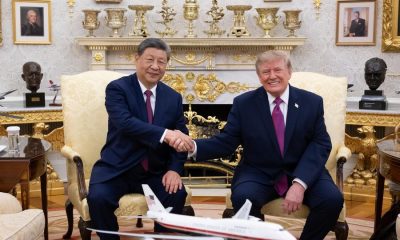
Chinese President Xi Jinping and U.S. President Donald Trump have moved to broaden the foundation of China-U.S. relations beyond trade disputes and strategic competition, placing artificial intelligence, youth exchanges and people-to-people ties at the centre of their latest engagement in Washington.
The shift emerged from Xi’s state visit to the United States, where the two leaders agreed to build a constructive relationship of strategic stability based on respect, fairness and reciprocity.

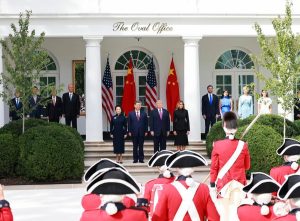
The visit produced a striking combination of diplomacy and symbolism: economic and trade arrangements, discussions on artificial intelligence, reciprocal state visits within months, a White House state dinner and a new Chinese invitation for 100,000 young Americans to visit China over the next five years.
For Xi, the message was that competition between the world’s two largest economies should not prevent cooperation in areas where both countries have shared interests.
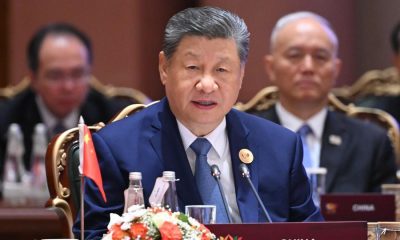
Speaking during his meetings with Trump, Xi said China and the United States had “deeply intertwined” interests and ample room for cooperation.
He acknowledged that the two countries compete in areas such as artificial intelligence but argued that their reasons for cooperating were even greater.
Xi called on the two sides to use their respective strengths rather than guard against each other, while ensuring that AI remains under human control and serves human progress.
Trump also highlighted AI as an area requiring continued dialogue, describing the technology as one that bears on humanity’s future.
A Different Kind Of China-U.S. Reset
The latest engagement is significant because it extends beyond the traditional focus on tariffs, trade balances and strategic competition.
During Xi’s visit, both leaders repeatedly returned to the role of ordinary citizens in shaping the future of bilateral relations.
Xi announced that China would invite 100,000 young Americans to the country over the next five years for study and exchange programmes.
The initiative doubles the scale of a previous five-year programme announced by Xi in 2023, when he invited 50,000 young Americans to China. That target has already been achieved.
“The hope of the China-U.S. relationship lies in our people, and its future lies with the young,” Xi said.
The Chinese president also announced that two pandas, Ping Ping and Fu Shuang, would soon arrive at Zoo Atlanta, providing another highly visible symbol of renewed people-to-people engagement.
Kenneth Quinn, president emeritus of the World Food Prize Foundation, described the expansion of student exchanges as significant, arguing that young people travelling between the two countries could deepen understanding.
From Washington To Beijing In Six Months
The pace of engagement between Xi and Trump has also been notable.
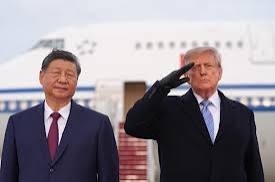
Xi’s Washington visit came less than six months after Trump travelled to China in May, when the two leaders agreed to work towards a constructive China-U.S. relationship of strategic stability.
In Washington, Xi said the next task was to turn that vision into action.
He proposed a relationship in which cooperation remains the mainstay, competition is moderate, differences are manageable and peace is protected.
The Chinese leader said both countries could benefit from practical cooperation and healthy competition while managing disagreements through mutual respect and a search for common ground.
Trump described Xi’s state visit as constructive and successful, saying the two leaders had conducted in-depth exchanges on bilateral relations and major international and regional issues.
He also said he looked forward to maintaining close contact with Xi and jointly guiding the relationship.
Trade Still Matters
Despite the broader emphasis on technology and people-to-people relations, economic cooperation remained at the heart of the summit.
Xi said the latest round of economic and trade consultations had produced a new joint arrangement, describing the outcome as beneficial to businesses and people in both countries and to the global economy.
He stressed that cooperation must work both ways and should be based on equality, mutual respect and mutual benefit.
The comments point to an effort to separate areas of practical economic cooperation from the broader strategic competition between Beijing and Washington.
The Archives And The Message Of History
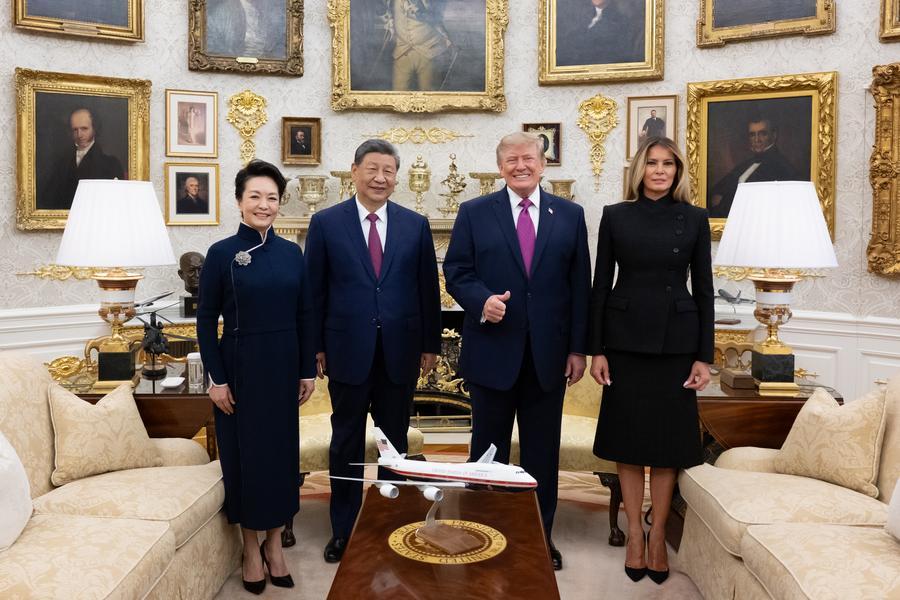
The symbolism of Xi’s visit was reinforced by his joint appearance with Trump at the U.S. National Archives.
After their tea meeting, Xi and his wife, Peng Liyuan, accompanied Trump and Melania Trump into the central hall of the archives, where they were briefed on its collections.
Xi described the institution as a repository of the wisdom of previous generations and a source of lessons for the future.
He used the occasion to acknowledge the profound differences between China and the United States, including their histories, cultures, social systems and development paths.
But he said those differences did not alter the common aspiration of their peoples for better lives.
If the two countries could respect their differences, deepen mutual understanding, learn from one another and expand cooperation, Xi said, their relationship could enjoy steady and sustained growth.
The Bigger Test
The latest summit does not remove the differences that have made China-U.S. relations increasingly complex.
Washington and Beijing remain competitors in technology and other strategic areas, while trade remains a sensitive component of the relationship.
What has changed in the latest engagement is the emphasis placed on mechanisms for managing those differences while expanding cooperation.
AI has been placed alongside trade as a potential area for dialogue. Youth exchanges have been elevated as a tool of long-term diplomacy. Reciprocal presidential visits have provided a channel for sustained leader-level communication.
At a White House state dinner, Xi pointed out that the exchange of state visits within less than six months had made history in bilateral engagement.
The challenge now is implementation.
The strategic language agreed by Xi and Trump will have to translate into practical cooperation, sustained dialogue and concrete exchanges if the new framework is to produce lasting stability.
But by placing technology, young people and direct engagement alongside trade and strategic issues, the Washington summit has broadened the conversation about what the future of China-U.S. relations could look like.