Governance
President Tinubu, ECOWAS Leaders Chart New Path to Regional Integration, Economic Revival

By Admin
Nigerian President, Bola Ahmed Tinubu has called on West African leaders to urgently address the region’s persistent failure to achieve meaningful economic integration, warning that intra-regional trade remains below 10 percent—an unsustainable level that risks leaving the sub-region behind in the global economy.


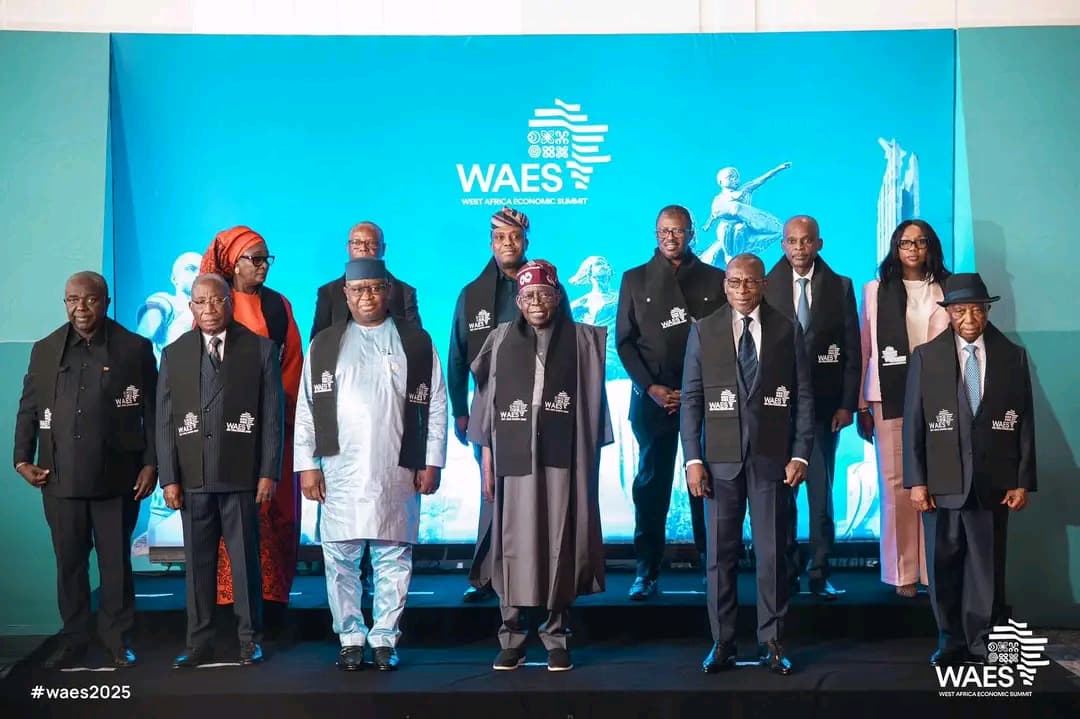
Delivering the opening address at the ECOWAS Investment Forum and Heads of State Summit in Abuja on Saturday, Mr Tinubu, who also chairs the ECOWAS Authority of Heads of State and Government, described West Africa as one of the last frontiers of economic growth. But he cautioned that “opportunity alone does not guarantee transformation.”
“Intra-regional trade remains under 10%—a challenge we can no longer afford to ignore. The low trade is not due to a failure of will but a coordination failure,” the president said.
He urged ECOWAS countries to move beyond reliance on external partners and instead build stronger regional value chains, invest in infrastructure, harmonise policies, and commit to long-term vision and capital alignment.
Tinubu emphasised the importance of West Africa’s youthful population, describing it as a potential driver of innovation and prosperity—but also a potential liability without adequate investment in education, digital infrastructure, and entrepreneurship.
“No one country can do this alone,” he said. “Our prosperity depends on regional supply chains, energy networks, and data frameworks. We must design them together or they will collapse separately.”
He pointed to Nigeria’s domestic investments in digital connectivity and youth empowerment as examples but maintained that collaboration across borders is essential to sustain and scale such progress.
The Nigerian leader also highlighted the region’s vast mineral wealth, arguing that West Africa must move beyond exporting raw materials and embrace local processing and manufacturing.
“The era of pit to port must end. We must turn our mineral wealth into domestic economic value jobs, technology, and manufacturing,” Mr Tinubu declared.
He added that meaningful change would not come from government alone, but from unleashing the entrepreneurial spirit of the people, with governments providing the right enabling environment through market-friendly laws, order, and infrastructure.
Gambian President Adama Barrow, in his remarks, noted that the region already possesses instruments necessary for integration—including the ECOWAS Trade Liberalisation Scheme and the Common External Tariff—but suffers from poor implementation.
“If these instruments exist, the problem is how to implement them. We must now remove all barriers to trade and support regional businesses,” he said.
He called the summit timely and necessary, expressing hope that it would lay the groundwork for real policy coordination and accountability.
President Patrice Talon of Benin Republic offered a candid critique of Africa’s implementation gaps, noting that the region does not lack vision or ideals, but consistently fails to actualise them.
“It is not the will that is lacking,” Mr Talon said. “Our main failure and the cause of our underdevelopment is our inability to put our ideals into practice.”
He appealed for a new dynamic in Nigeria–Benin relations, describing both countries as culturally and geographically intertwined. “Let us show that this integration is possible,” he urged.
Sierra Leone’s President Julius Maada Bio advocated for a single West African currency to reduce exchange rate risks and boost trade. He called for modernised customs systems, improved infrastructure, and harmonised trade policies.
“Trade integration must begin with strong political will,” he said. “We must act decisively to reduce tariffs and facilitate mobility across borders.”
He also stressed the need to empower the region’s youth through skills development, support for start-ups, and targeted investment in innovation.
Liberian President Joseph Boakai highlighted his country’s recent election to the United Nations Security Council as a sign of growing international credibility and responsibility. He reaffirmed Liberia’s commitment to the African Continental Free Trade Area (AfCFTA) and regional value chains.
He listed Liberia’s investment priorities as including: Sustainable agriculture and agribusiness, Road and port development, Energy access and affordability, A robust digital economy, and Youth-led innovation.
“This summit provides a vital platform for reflection, coordination, and a renewed commitment to our sub-region’s economic transformation,” Mr Boakai said.
The consensus among ECOWAS leaders was clear: the region must urgently pivot from policy declarations to implementation. With challenges ranging from geopolitical instability and public debt to food insecurity and weak infrastructure, the need for regional coherence has never been greater.
President Tinubu concluded with a charge to the summit participants:
“Let us emerge from this summit with actionable outcomes: a renewed commitment to ease of doing business, enhanced intra-regional trade, improved infrastructure connectivity, and innovative ideas that move our people from poverty to prosperity.”
He called for a West Africa that is “investable, competitive, and resilient—one that leads with vision, responsibility, and unity.”