International
Trans-African Tourism and Unity Campaign Urges Visa-Free Africa …says a borderless Africa would unlock economic growth

By Iyojo Ameh
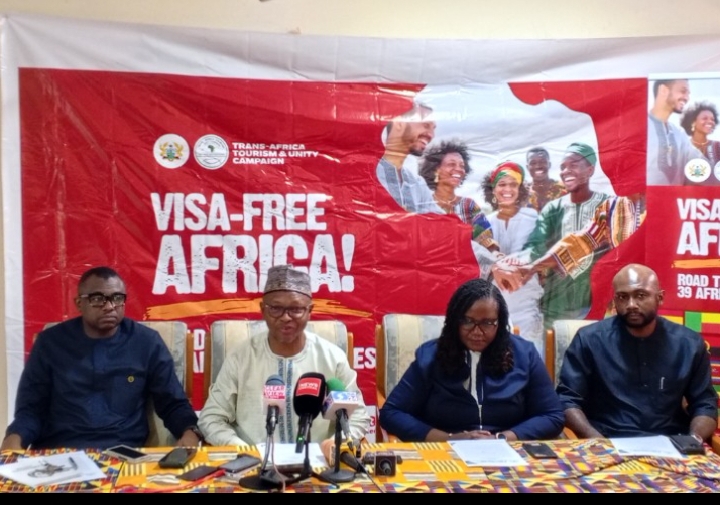
The Trans-African Tourism and Unity Campaign has renewed calls for the removal of visa restrictions across the continent, saying a borderless Africa would unlock economic growth, expand tourism, and accelerate the African Union’s vision of integration.
Addressing journalists in Abuja on Monday, the campaign’s leader, Ras Mubarak, described Nigeria’s capital as a “beacon of unity and progress” and a fitting stop on their 40,000-kilometre journey across 39 countries to advocate for visa-free travel.
The delegation, which arrived in Abuja on August 22 after passing through Ghana, Togo, and Benin Republic, praised the city’s “cleanliness, greenery, and landmarks” such as Millennium Park, Jabi Lake, and the Arts and Crafts Village.
“Our mission is clear: dismantle visa barriers that fragment our continent and hinder the free movement of 1.4 billion Africans,” Mubarak said. “These restrictions are relics of colonial divisions and stand in direct contradiction to the AU’s Agenda 2063.”
The campaigners noted the high financial and human costs of current visa regimes, revealing that their team of eight spent $11,800 on visas alone. “That money could have gone into fuel, food, or souvenirs. Instead, it was wasted on bureaucracy,” they said.

They argued that Africa is losing out on a booming global tourism market worth $9 trillion, with the continent currently generating just $1.9 billion annually. “By opening our borders, beautifying our cities, and ensuring security, Africa can quadruple its earnings from tourism,” they added.
Examples were cited from Kenya and Benin Republic, which have eliminated visa requirements for African nationals, while Ghana recently announced a similar policy. The group urged Nigeria and other major African economies to adopt and expand visa-on-arrival frameworks, champion the AU’s Free Movement Protocol, and lead efforts toward a borderless continent by 2030.
During the Abuja briefing, the delegation also identified suspicion among African states and extortion by border officials as major obstacles to free movement. They called for “a cultural shift to view fellow Africans as partners, not threats.”
In a lighter moment, the group rekindled the long-running Nigeria–Ghana jollof rice rivalry while encouraging Nigerians to “amplify Abuja’s beauty” and showcase the city as a gateway for intra-African tourism.
From Nigeria, the campaign will continue through Cameroon, Equatorial Guinea, Gabon, DR Congo, Angola, Botswana, and South Africa, before concluding in Ghana in January 2026.
“Our choice is simple: unity or division, insecurity or prosperity,” Mubarak declared. “Africa can thrive with open borders not by 2063, but by 2030 with Nigeria leading the way.”