News
FG, China Partner To Localise CNG, EV Infrastructure Manufacturing In Nigeria

The Federal Government of Nigeria and a Chinese firm, New Power Technology (NPT), Monday, engaged in a strategic partnership to localise the manufacturing and assembly of Compressed Natural Gas (CNG) and electric vehicle (EV) infrastructure in Nigeria.
The partnership, which is fully backed by the Chinese government, will focus on the local production and assembly of CNG dispensers, refuelling stations and EV charging facilities, as part of Nigeria’s efforts to deepen local content, reduce import dependence and accelerate the adoption of cleaner transport energy.
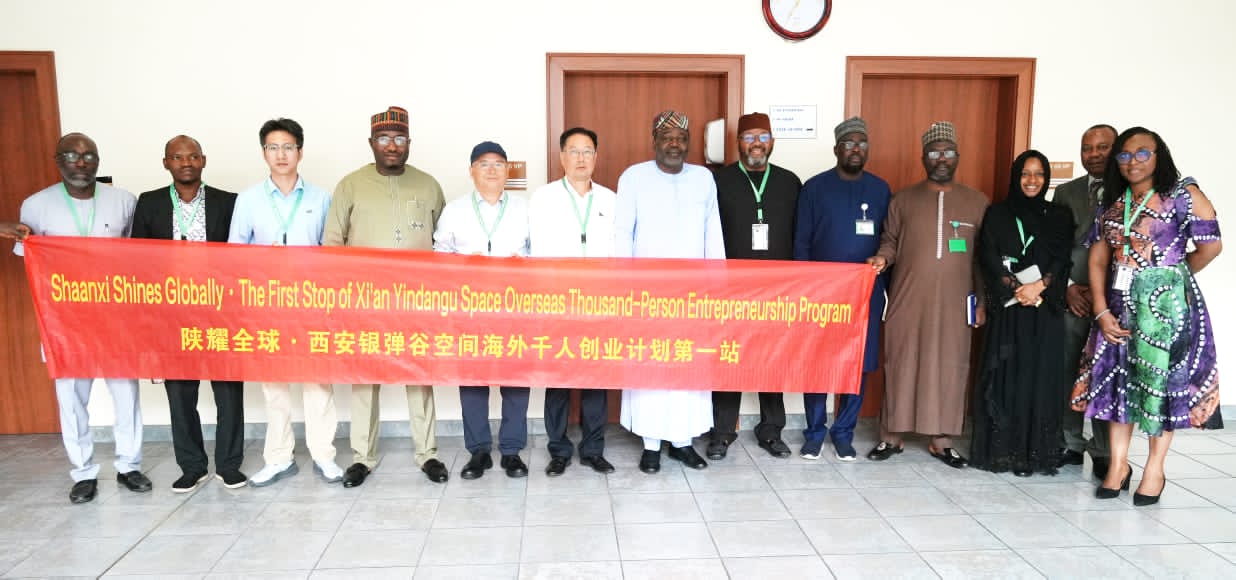
This was the outcome of a meeting of a delegation from the NPT, led by its Chief Executive Officer (CEO), Mr. Liu Shihua, as well as the management team of the Presidential Compressed Natural Gas Initiative (PCNGi), Barrister Ismaeel Ahmed with the Vice President, Senator Kashim Shettima, at the Presidential Villa, Abuja.

The Vice President, who was represented by the Deputy Chief of Staff to the President, Senator Ibrahim Hassan Hadejia, said the move, which aligns with President Bola Tinubu’s directive on mandatory procurement of CNG-powered vehicles by all government institutions in the country, will address transportation challenges in the country.
Senator Shettima said the target of training 100,000 Nigerians – not less than 1,000 in each state locally – and sponsor 100 of them to go to China for training is also part of the inclusivity clause of the President under the Renewed Agenda.
He acknowledged that while Nigeria is considered the world’s largest emerging market, with an average age of 21.4 years, its market is similar to China’s in the 1980s, and holds the promise for replicating China’s successful experience in electrifying transportation.
“A clean and green transportation transformation can be achieved by introducing China’s high-tech bio-environmental systems. Localization improvements and training are key to replicating success and attracting investor attention,” he stated.
Senator Shettima also lauded the Chinese government’s offer to provide policy and financial support for the the construction of electric vehicles and charging infrastructure, the VP said multiple visits to Chinese factories have secured preferential prices for electric vehicles, charging stations, and other equipment.
He commended the Chinese firm for promoting the human capital drive of the Tinubu administration through the “development of approximately 10 chip engineering vehicle projects within three years, building an electronic chip industry chain, with emphasis on training local talent, especially women and vulnerable groups, demonstrating social responsibility.”
Earlier, CEO of NPT, Mr. Shihua, told the Vice President that the the target is to build a complete electric vehicle ecosystem, including a vehicle retrofitting and battery swapping networks, digital operation and maintenance platforms.
“Our plan is to complete the conversion of one million traditional fuel-powered tricycles to electric tricycles within three years, while simultaneously establishing 10,000 charging and swapping stations, directly creating 40,000 to 50,000 jobs in the charging and swapping sector.
*We’ll bring a core team of Chinese technical experts. We will station experienced Chinese engineers in Nigeria to provide comprehensive technical support and personnel training. What’s more, a local government in China – the Science and Technology Bureau of Xi’an, Shaanxi Province – is providing strong policy and talent support through its “Thousand Talents Program,” he said.
He further noted that the firm will train local technical backbones for Nigeria in the next three years, and support 60 to 70 outstanding Nigerian students to study in China under fully funded programs.
“After they return, these technical backbones will act as seed trainers, each helping to train 1,000 local technicians in every state of Nigeria – that means more than 37,000 local engineers across the country. This is how we achieve “technology stays, capacity takes root,” he added.
Shedding more light on the strategic partnership, the Technical Adviser to the President on Economic and Financial Inclusion (Office of the Vice President), Dr Nurudeen Zauro, noted that it is part of the mandate of President Tinubu for the Presidential Committee on Economic and Financial Inclusion to implement a collaboration and partnership to achieve the $1 trillion economy target.
He said, “We have been engaging with partners locally and internationally who are privileged. I was privileged to be part of the team that visited their factory in China. And we saw very fantastic innovation technology that they have, particularly around electric vehicles, charging solutions, conversion centres, as well as electric tricycles.
“In the light of that, we engaged in conversation with them. Then they gladly accepted to come to Nigeria. They visited our embassy in Beijing, and they came here in order to support the mandate of Mr. President.”
On his part, the Executive Chairman of the Presidential Compressed Natural Gas Initiative (PCNGi), Barrister Ismaeel Ahmed, said the Chinese firm, NPT, is fully backed by the Chinese Government, noting that the partnership will reduce transportation cost in the country.
“As you well know, this is a 240 million people country with a rising demand for transportation. Transportation takes about 15 to 25 percent of daily income of all household across all classes of the people.
“So, it is a very important partnership and it is a signature project for President Bola Tinubu, especially with the introduction of the PICNG and EV. We are collaborating and looking at the options they are bringing to the table to see how we can do a fast deployment so that we can reduce transportation cost for the people and generally increase the value of their livelihoods,” he stated.