International
Nigeria, Benin Sign Landmark Integration Pact as Presidents Tinubu, Talon Call for Urgent ECOWAS Reforms

By Iyojo Ameh
Nigeria and the Republic of Benin on Saturday signed a historic bilateral agreement aimed at deepening integration and setting a precedent for broader regional cooperation within the Economic Community of West African States (ECOWAS).
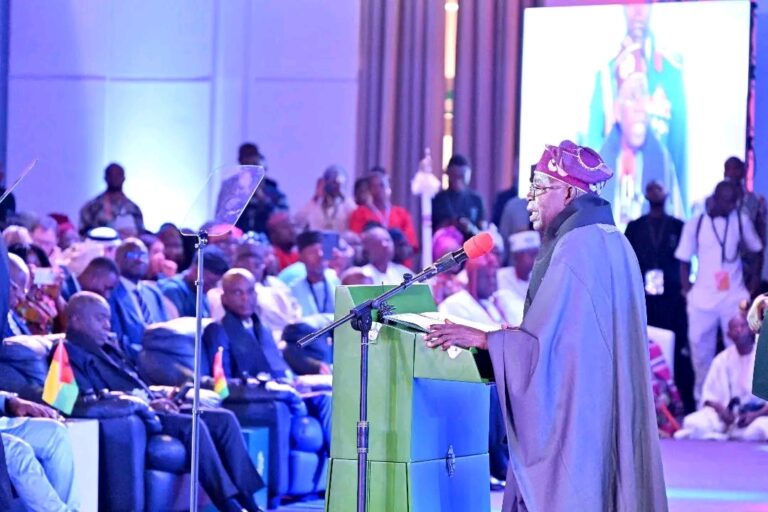
The signing ceremony took place on the sidelines of the inaugural West Africa Economic Summit (WAES) in Abuja, in the presence of Nigerian President Bola Ahmed Tinubu and his Beninese counterpart, President Patrice Talon.
Nigeria’s Minister of Industry, Trade and Investment, Dr. Jumoke Oduwole, and Minister of State for Foreign Affairs, Ambassador Bianca Odumegwu-Ojukwu, signed the agreement for Nigeria. Representing Benin were Minister of Industry and Trade, Shadiya Alimatou Assouman, and Minister of Foreign Affairs and Cooperation, Shegun Adjadi Bakari.
President Talon described the agreement as a bold step toward achieving real and actionable regional integration.
“President Tinubu and I have agreed on full integration between Benin and Nigeria. The responsibility now lies with our ministers to implement it. Benin and Nigeria are more than twins, we are the same people. Let us show the region that integration is possible,” Talon declared.
However, Talon also issued a stark warning about the state of ECOWAS, calling it “a perfect example of regional integration” that is currently “in crisis.” He cited the West African Gas Pipeline as a failed initiative due to bureaucratic bottlenecks.
“It is ridiculous. This failure of regional cooperation wastes resources and undermines integration,” he said, revealing that Benin has resorted to importing gas from Qatar via a floating storage and regasification unit (FSRU).
He also criticized the dysfunction of the West African Power Pool, despite significant investments.
“We invested heavily in this infrastructure. But it is not functioning as expected. Unless we act decisively, I’m not confident it ever will.”
Talon addressed logistical issues plaguing the Lagos–Abidjan Corridor, where businesses face delays and harassment at multiple checkpoints.
“The road exists. But a businessman should be able to travel from Lagos to Abidjan in hours not days without facing harassment. That is not integration.”
He emphasized that poverty remains the most dangerous destabilizing force in the region.
“Poverty is the main threat to democracy, security, and stability. If we do not address poverty through integration, our values will remain hollow.”
Referencing shifting global trade dynamics, Talon cited U.S. President Donald Trump’s protectionist policies as a wake-up call for Africa.
“The trade war should remind us that nations act in their interest, and so should we. At some point, we may even have to thank President Trump for that reminder.”
He concluded by urging West African leaders to act with urgency.
“If we cannot create wealth and opportunity, all our other values—democracy, liberty cannot be sustained. Integration must be real. Integration must be delivered.”
Earlier, the Presidents of Sierra Leone and Liberia joined Talon in delivering national statements at the summit, which precedes the 67th Ordinary Session of the ECOWAS Authority of Heads of State and Government, scheduled for Sunday, June 23, at the State House Conference Centre, Abuja.
Liberian President Joseph Boakai reaffirmed his country’s commitment to ECOWAS and the Mano River Union, stressing the need to reduce trade barriers and harmonize policies.
“This summit offers a vital platform for reflection, coordination, and renewed commitment to the economic transformation of our subregion,” Boakai said, commending President Tinubu for convening the strategic gathering.
President Julius Maada Bio of Sierra Leone emphasized unlocking West Africa’s economic potential amid mounting global pressures such as public debt, climate change, and food insecurity.
“Trade integration must start with a strong political commitment,” he said, urging deeper engagement in ECOWAS initiatives like the Trade Liberalisation Scheme and Common External Tariff.
President Bio also backed the idea of a single regional currency.
“A single currency would reduce exchange rate costs, support price stability, and improve the business environment,” he said.
The summit also featured recorded messages from UN Deputy Secretary-General Amina Mohammed and WTO Director-General Dr. Ngozi Okonjo-Iweala, reinforcing the call for African-led economic cooperation and inclusive trade policies.