Agriculture
West Africa Pushes Agroecology as Climate Change, Food Insecurity Threaten Region’s Future

By Iyojo Ameh
Policymakers, researchers, farmers and development partners from across West Africa on Wednesday launched a renewed campaign to accelerate the adoption of agroecology, describing it as a critical solution to worsening food insecurity, climate change and fragile agricultural systems across the region.
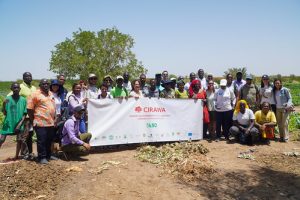
The call came at the opening of the CIRAWA Agroecology Conference in Accra, Ghana, where stakeholders from Ghana, Senegal, The Gambia, Cape Verde and Europe gathered to explore practical pathways for scaling agroecological practices under the European Union-funded CIRAWA project.
Opening the three-day conference through a statement delivered by her Chief of Staff, Alex Percival Segbefia, Ghana’s Vice President, Professor Naana Jane Opoku-Agyemang, said the country was committed to mainstreaming agroecology as part of its broader agricultural transformation agenda.
She stressed that Africa must move beyond farming systems that no longer deliver sustainable results and embrace approaches capable of improving productivity while protecting the environment.
According to the Vice President, the Ghanaian government will continue promoting crop diversification, agroforestry, improved soil fertility through composting, biofertilisers and biopesticides, farmer-led irrigation, simple mechanisation technologies and the local production of improved seed varieties.

She also called for the development of a national agroecology strategy, saying it would support the transformation of food systems while advancing several Sustainable Development Goals.
Speaking at the event, UNESCO’s Head of Office in Accra, Edmond Moukala, described the conference as a defining moment where science, public policy and indigenous knowledge converge to address one of humanity’s greatest challenges—feeding a growing population while restoring degraded ecosystems.
He warned that Africa continues to bear the brunt of a climate crisis it did little to create, arguing that agroecology offers the continent an opportunity to strengthen food sovereignty and reduce dependence on vulnerable global food supply chains.
“Agroecology is not just a farming method; it is an act of resistance and a pathway for African countries to regain control of their food systems,” he said.
Professor Saa Dittoh of the University for Development Studies (UDS), Tamale, and Ghana Coordinator of the CIRAWA project, urged governments across West Africa to place agroecology at the centre of national agricultural policies.
He noted that while some East African countries have made significant progress in integrating agroecological principles into national development plans, West Africa still lags behind.
According to him, a successful agroecological transition will depend on stronger political commitment, scientific innovation and coordinated action involving governments, researchers, farmers and civil society organisations.
The conference, which runs until July 3, features keynote addresses, technical workshops and policy dialogues aimed at strengthening collaboration among governments, research institutions and farming communities
Organisers said discussions would focus on overcoming barriers to agroecological transition, improving food security, enhancing rural livelihoods and building climate-resilient agricultural systems capable of sustaining future generations across West Africa.
The CIRAWA project brings together 16 partners from nine countries to develop and promote agroecological innovations for smallholder farmers in Ghana, Senegal, The Gambia and Cape Verde, with the goal of improving nutrition, livelihoods and ecosystem health while creating more resilient regional food systems.